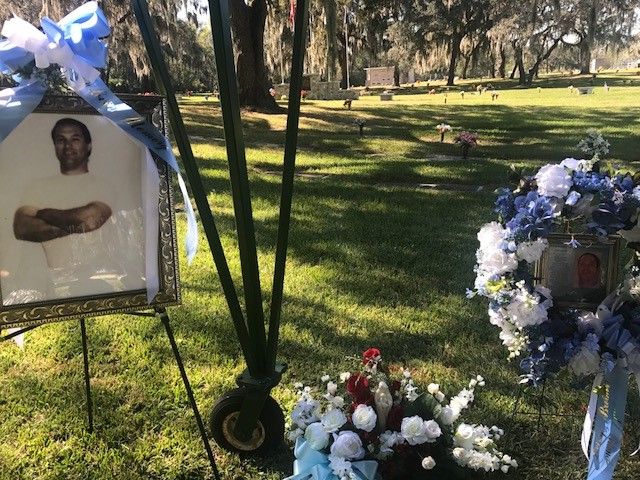
Our Dear Friend Mike Lambrix left us on October 5, 2017
He went from the Darkness to the Light..

Thursday, March 16, 2017

Death Watch Journal (part 29)

Written March 12, 2017

Breaking News! On Thursday March 9, the Florida Supreme Court denied my long pending appeal and specifically lifted the previous “stay of execution,” effectively setting the stage for Governor Rick Scott to reschedule my execution within the near future.

As most reading this already know, all executions in Florida have been on hold since the state supreme court granted me a stay of execution on February 2, 2016 to consider whether the US Supreme Court’s January 2016 decision in Hurst v Florida applied to all previously imposed death sentence, such as mine.

Subsequently, in December 2016, the Florida court issued a decision in Mark Asay v State in which the court recognized that in light of the Hurst v Florida decision there was no question that anyone who was condemned to death by less than a unanimous jury vote was unconstitutionally sentenced.

However, in Asay v State, and its companion case of John Mosley v State, a marginal majority of the court ruled that they would only grant relief from illegally imposed death sentences to those whose sentences were imposed and final, after June 2002 (when the US Supreme Court issued its earlier decision that formed the foundation for the Hurst v Florida decision).

That meant that those illegally sentenced after 2002 would have their death sentences thrown out, but those whose sentences were “final” on their first direct appeal prior to June 2002 would not get relief.

Many in the media and elsewhere have since publicly questioned this finding, arguing that it is fundamentally unfair and makes no sense. That the court would recognize that the death sentences were unquestionably illegal, but that it would allow those sentenced prior to 2002 to be executed, while those sentenced after 2002 would be granted relief.


This point will undoubtedly be argued before the US Supreme Court. What must be emphasized is that what the Florida court did in arbitrarily cutting off retroactive relief at 2002 is clearly unprecedented. No other court has ever held that once a substantive new rule of law entitles to retroactive relief, they would only apply it so some, but not to others. A new rule of law is either retroactive or it is not.

The question now is whether the Supreme Court will accept review of this issue quickly. The Court accepts very few cases each year - and whether or not they accept a review is completely within their own discretion.

For this reason, it took 14 years (and 47 illegal executions) before the Court finally agreed to review a case that argued that under Ring v Arizona (2002) those sentenced to death were entitled to relief. When the Court did finally grant review in Hurst v Florida, they all but unanimously agree that Florida was illegally sentencing all of us to death.

It’s all but certain that the Court will eventually accept review of the recent Florida Supreme Court ruling of partial retroactivity — but it could take another 14 years and many more executions, and by that time I may be long dead.

In the recent decision denying my appeal and lifting the stay of execution, the Florida court did grant leave to file a motion for rehearing, so within 15 days (no later than March 24) my lawyers will file a Motion for Rehearing challenging this ruling, but it will almost certainly be denied within a matter of days, and I expect that the governor will most likely reschedule my execution before the end of this month. When that is done, the date will probably be set for some time around the end of April.

However, let me emphasize that although this Hurst issue has been getting all the attention, this is not the only legal issue being pursued in my case, and I do have other appeals pending. In the decision denying me relief they also (again) denied my request for DNA testing of evidence that would support my claim of actual innocence. This denial will be pursued further.

Additionally, separate from this state court appeal, in 2015 my lawyers filed a comprehensive appeal in the federal courts arguing that I am constitutionally entitled to have full review of the readily available evidence sustaining my actual innocence and that appeal remains pending before the Federal Court of Appeals (Lambrix v Secretary, Dept of Corrections, Eleventh Circuit case no. 16-10251).

Recently, the Supreme Court issued a decision in a Texas Capital case (Buck v Davis) that provides strong support for my claim of entitlement to full federal court reviews of my substantiated innocence claim and I remain hopeful that, based on the case, my federal appeal will not be formally re-opened, and fully reviewed. If this is done, I am confident that my convictions will be thrown out and I will be legally exonerated.

Because lawyers who represented me many years ago did not “timely” present my substantiated claim of innocence to the state courts in my original post-conviction appeal (in 1988), under politically manufactures rules designed to speed up executions, all evidence substantiating my innocence has been “procedurally barred” from review before both the state and federal courts. But the 2012 USSC case of Martinez v Ryan opened the door to finally overcome that procedural bar and have my innocence claim heard.

But the federal courts in Florida and Texas have categorically refused to allow death sentenced prisoners to reopen their federal appeals under this 2012 Martinez rule. The recent USSC ruling in Buck v Davis should now force these pro death penalty judges who control the Florida federal courts to now reopen my case and allow the evidence substantiating my innocence to be heard — at least I hope so.

But for now, I’m going to have to dance with death again, soon.

Sunday, March 12, 2017

Mike Lambrix Loses Appeal, Opens Door For Execution

Friday, March 10, 2017


The Florida Supreme Court  has lifted the stay on Mike's death warrant, and he could find himself with a new execution date. Read it here 


Death Watch Journal (Part 28)

March 2, 2017

Sometimes I wonder whether this thing called "hope" is my greatest adversary, existing only to torment me, to break me...could hope be my nemesis, capable of a conscious form of malevolence not unlike the fictional sirens depicted in Homer's "Odyssey", their seductive charm luring the passing sailors to their death, and so too does this entity of hope haunt me on countless sleepless nights as I grasp desperately upon those fragile strings of hope as I look down into that darkness of the abyss beneath me.

I remember the one scene in the movie "Shawshank Redemption", where the old and experienced convict (Morgan Freeman) sat in the prison chow hall, offering his sage advice to the new arrivals...telling them to forget about hope of freedom, as it will drive you crazy - maybe he was right.

As I write this today, it is March 2, 2017, and today marks exactly 34 years since I was arrested on these capital charges that subsequently led to me being convicted and condemned to death for a crime I did not commit.

It's been a long and hard journey and sometimes I wonder how I have managed to maintain my sanity - and again, sometimes I wonder whether I really have as perhaps I'm the only one who cannot see that I actually went nuts years ago.

Last year I yet again counted down the days to my own scheduled execution, only to receive a 'temporary stay of execution' and was removed from my "death watch cell" two days before I was to die. It wasn't the first time that I faced relatively imminent execution and I know the State of Florida will continue to use all available resources at their disposal to have me executed yet.

For most of the past year I had reason to hope that the January 2016 decision by the US Supreme Court in Hurst v Florida, 136 S.Ct. 616 (2016) (which declared that the manner in which Florida imposes a sentence of death - allowing a judge rather than the jury make the ultimate decision on death, violated long standing fundamental constitutional rights that rendered such death sentences illegal) would lead to having my own death sentences thrown out. In fact, this is the issue that the Florida Supreme Court ordered a stay of execution on.


But on December 22, 201 - just before Christmas - the Florida Supreme Court crushed that hope when it issued it's ruling in Mark Asay v State of Florida recognizing that under Hurst v Florida there was no question Florida death sentences were imposed illegally and finding that all those sentenced to death after 2002 would be entitled to have their illegally imposed death sentences vacated - but that because it would be too much of a burden on the State to correct all these illegally imposed sentences, they would not throw out the death sentences imposed prior to 2002. My death sentence was imposed in 1984 and was affirmed on direct appeal in 1986, which meant that under Asay v State, I would not be entitled to relief under Hurst v Florida. Just that quickly, my hopes were crushed.

Although the Florida Supreme Court still has not actually issued any ruling in my own case yet, I had to accept that when they did, they would deny my appeal consistent with Asay v State, as they have numerous other similar pre-2002 capital cases in the past few months.

With my hope of being granted relief crushed, I began to mentally prepare myself for what I was sure would soon follow...the denial of relief in my case and having my previously stayed execution rescheduled.

Since that decision in Asay v State that seemingly sealed my fate, I spent the last two months letting my family and friends know that they should expect the court to soon deny my appeal, and that I would then be recheduled for execution again - and since the state and federal courts have consistently refused to even look at the readily available evidence substantiating my consistently plead claim of innocence, they should be prepared for that rescheduled execution carried out.

Clearly, I felt that there was no reason to yet again hope for any chance of proving my innocence, and mentally I prepared myself to die, and I was not alone as when I shared this news with others, while most of those closest to me stood by me that much more, a few apparently decided that they didn't want to stick around just to watch me die and I haven't heard from them since - and who could blame them?

Little by little I began going through my personal property, weeding out what I would throw away so that when I was put to death it wouldn't be a burden on my family...I was prepared to die, again.

Then out of the blue come the phone call from my lawyers the other day, letting me know that on February 22, 2017 the US Supreme Court issued it's decision in the Texas capital case of  Duane Buck v Davis, in which the court addressed the issue of whether a prisoner can seek and be granted relief on a previously denied federal appeal based upon ineffectiveness of legal counsel in that earlier appeal, by employing a procedural motion to reopen that earlier case under Federal Rule of Procedure 60 (b), and the court agreed that equitable relief under extraordinary circumstances to prevent manifest injustice would be pursued and granted under Rule 60 (b).

Suddenly hope again sprung forth - the Supreme Courts unequivocal recognition that relief from an unjust conviction or death sentence could be granted by way of Rule 60 (b) meant that my own long pending Federal appeal arguing exactly that point would now have to be granted, opening the procedural door to finally receiving a full review of all the evidence substantiating my innocence. And if allowed to be heard, I would finally be exonerated, and win my fight for my freedom.

For the next few days I felt giddy - more than just happy, I was elated, especially when I was able to share this good news with my family, as they too hung desperately to every string of hope.

But as is the nature of hope, after that initial elation ran it's course, I found myself slowly sinking back into the depths of hopelessness and despair, reminding myself that in these past 34 years again and again I allowed myself to become convinced that truth and justice would prevail, only to have that hope crushed.

This Buck v Davis case should compel the federal courts to finally address the evidence substantiating my innocence and by every right and reason I should be elated - that previously unyielding door has been cracked open, But if I've learned nothing else these past decade after decade, it is that you cannot count on our courts to do the right thing. And for that reason I will not throw myself upon the rocks as that seductive siren call of renewed hope tries yet again to suck me in.


Death Watch Journal (Part 27)

I write this (February 20, 2017), I continue to await the Florida Supreme Court decision in my case. Every Tuesday I tried to catch the P.B.S "Capital Update" on the local news, as they will often report on decisions issued by the court. And then on Friday afternoon my lawyers will schedule a phone call so that they can tell me if any decision has been issued.

Let me explain just how this goes. Here at Florida State Prison the wing that houses those under sentence of death is located almost at the very end of a very long hallway - a straight corridor that runs from one end of the prison to the other. I've walked that walk so many times through the too many years, and it averages about 600 steps, and I go through three separate electronically controlled security gates to get from the death row wing to where the area for lawyer visits and phone calls is.


It's a long walk and a lot of time to think about what the lawyers might tell me when I do finally get on the phone. Of course, since all death sentenced prisoners are fully restrained whenever we are removed from our solitary cells in full leg shackles, handcuffs and waist chains, that long walk is more like one short shuffle step at a time and if you do try to get too fast the leg shackles will cut into the back of your ankles and make a bloody mess.

As I make that journey I'm escorted every step of the way by one of the guards and I make a point of trying to keep my mind of what news may be waiting me when I do get to that phone reserved for legal calls, so I will talk to whichever guard may be by my side that day and I get along with most so will engage in casual conversation almost as if we were strolling a park together.

When we finally reach what is commonly known as "the colonel's office", I'm then escorted into a small office that has a plain small table desk with two chairs, and a phone on the table. They keep me restrained the whole time that I am in there, even though I will be securely locked in that small room by myself during that phone call as legal communication, whether in personal visits, phone calls or by mail, is considered to be "privileged and confidential" so they are not supposed to listen in, although I must admit that at times my paranoia will compel me to to wonder whether they are listening.

So, they will then connect me to my lawyers, who maintain their office in South Florida, and we will have 30 minutes. Again, because I must remain physically restrained at all times, I cannot actually pick up the phone receiver, so instead I will wait until the red light comes on indicating that the call has been connected, then I will push the button marked "Line 1", and then wait to hear a voice on the other end.

A long running joke I have with my lawyers of many years is that once that phone call is connected, from time to time one of them will say "hi" and I will immediately respond: "No I'm not - they drug test us!", and we will have a little laugh. And it's true, I cannot be "high" as for at least the past 23 years now they have been randomly drug testing prisoners and I've taken many drug tests, and never once failed one.

The truth of the matter is that being condemned to death has almost made me a saint. I don't smoke - I did long ago, but quit that nasty habit way back in my early years on the row. I don't drink (probably could if I wanted to, but I don't want to), not do I do any drugs, although I do still wonder from time to time whether maybe this "reality" I'm trapped here in (death row) isn't really real at all, but merely a bad acid trip and anytime now I'm going to wake up and exclaim; "wow!, y'all aren't going to believe the trip I just has!", and I don't even run around with wild women anymore - gotta admit  though, that's probably the one bad habit I miss the most as it does get really lonely here, I don't even cuss that much anymore - yeah, I probably am on my way to sainthood and only because I was condemned to death - kind of ironic huh?

Back to the phone call ...it's now been over a year since I received that stay of execution and each week I anxiously await word on whether the court has ruled. They've already decided the main issues relating to whether the January 2016 US Supreme Court ruling in Hurst v Florida will be applied retroactively and based upon their December23, 2016 ruling in Mark Asay v State of Florida, I already know that I will be denied relief on that issue as Like Asay, I was sentenced to death prior to 2002, and in Asay, the FSC said they will not grand relief from the indisputably illegally imposed sentence of death in cases in which that sentence of death was imposed prior to 2002.

And so each and every week I anxiously await that decision that will decide my fate, knowing that it will all but certainly be against me - and yet still clinging to that hope that for whatever reason the court will actually grant relief. And with every step of that long walk that possibility of what I might hear plays out in my head...the Florida Supreme Court generally releases it's decisions in capital cases around 11.00 AM each Thursday, so we do this phone calls on Fridays, and so each Friday begins when I wake up knowing that today may be the day that news comes.

You see, it's the continued uncertainty of my fate that weighs most heavily on my mind. I've heard it said that they can only kill you once, but I know that that is simply not true - every time I'm forced to confront my fate, I'm a part of me dies. Most define the death penalty only by that end result - the execution - and give no thought to anything else that the condemned prisoner and his family and friends go through.

But in truth, the contemporary death penalty is actually a lot like that old Chinese torture, commonly known as a 'death by thousand cuts', each little stab is never enough to kill you, but eventually enough small stabs will take their toll. And in it's own way, that's what the not merely days, or weeks, or months - or even years, but decades of death does to the condemned...each and every time he is forced to confront the uncertainty of his (or her) fate, it's another small stab that cuts deep down into the soul, a seemingly endless journey through a hell few can even begin to imagine.

And so i make that long walk week after week, at least so far each week being told that there has been no decision - and at least for that moment I feel that weight of confronting the uncertainty of my fate briefly lifted, but it doesn't take long before it quickly comes back, as just as soon as I complete the phone call and start to make that long way back, the anxiety of that same walk next week is already starting to creep in...as I said, it's not a quick death, but by deliberate intent and design, my condemnation is a death of thousand cuts.

Sunday, February 19, 2017

Death Watch Journal (Part 26)

I remember a cartoon I was read years ago. In the first frame it depicted a desert scene with a large cactus in the forefront and on the arm of that cactus were two vultures — the larger one presumably was the parent while the much smaller one was the younger child. But intently stared off into the distance. Across that great expanse of endless sand dunes and off in the distance there was what appeared to be a small dot with a puff of dust rising above it. The second frame showed the same scene, only now the small dot was much closer, and it could be seen as a man desperately crawling across the scorching, barren death, obviously on the brink of death, but stubbornly refusing to give up hope as he clawed his way forward. Both vultures sat silently, just watching as the man drew closer and closer. The third frame showed the man now almost immediately in front of the cactus, looking up towards the vultures with a look of desperation as the younger vulture began to jump up and down, all but screaming, “Can we get him now?” and the larger vulture calmly patted him on the shoulder, “Patience, Son, patience.” The fourth and final frame showed the man now crawling past and away from the vultures, a slight smile of hope and defiance as he seemingly escaped his inevitable fate. Now the younger vulture looked at his father with a look of malice and intent in his beady little eyes, and exclaimed, “Patience, my ass — let’s just kill the bastard!”

Well, the vultures are circling again and with each pass they draw just a bit closer, and I am that man desperately crawling across that barren desert. This time last year I was facing relatively certain imminent execution despite my innocence and had already ordered my last meal and been measured for the suit the state so generously bought for no other reason but to kill me in.

Then the Florida Supreme Court granted a “temporary” stay of execution and on February 9, only two days before my scheduled execution — I was removed from the death watch housing area and placed back on the regular wing housing death row at Florida State Prison, where I remain today.

Over the past year the state courts struggled with the question of whether the January 2016 U.S. Supreme Court case of Hurst v Florida would require all illegally imposed sentences of death to be thrown out. Until that issue was resolved, my stay of execution would remain in effect. As the months passed, numerous rulings gave us the hope that the Florida Supreme Court would do the right thing and rise above the only too common corruption of the Politics of Death.

When the Florida Supreme Court issued its own decision in October, 2016, in Hurst v State, in which the majority of the Court not only recognized that consistent with what the U.S. Supreme Court plainly stated in Hurst v Florida, the manner in which Florida imposed death sentences — all death sentences since 1974 — was unconstitutional, but went a step further to also add that the previously existing process violated even greater protections afforded under the Florida constitution  and that such illegally imposed death sentences amounted to the unconstitutional infliction of “cruel and unusual punishment,” we thought for sure the court would now throw out all these illegally imposed sentences of death.

As reflected in my previous blog posts, after that October 2016 decision in Hurst — and others that closely followed — it appeared that the Florida Supreme Court was going to do the right thing and upon recognizing that all death sentences were illegally imposed, retroactively apply Hurst and effectively vacate all Florida death sentences. It seemed that was the only logical conclusion.

But on December 23, 2016, perhaps reflecting the malice in their hearts by releasing these decisions just before Christmas, the Court issued its decisions in Mark Asay v State of Florida and John Mosley v. State of Florida in which any hope of having all death sentences vacated was quickly dispelled.

In Mosley, the Court concluded that there was no question that the U.S. Supreme Court opinion in Hurst v Florida made it clear that they were wrong when they previously decided that the 2002 case of Ring v Arizona did not apply to Florida’s cases. Of course, the FSC made no mention of the fact that since they were wrong in the 2002 case of Leroy Bottosin and Amos King, they had allowed 47 men (no women) to be put to death based upon which is now recognized as their own clear error.

The FSC then went on to recognize that since John Mosley was sentenced to death after that 2002 USSC decision of Ring v Arizona, fundamental fairness entitled him to relief from that illegally imposed death sentence, and the Court ordered his death sentence vacated, and a new sentencing.

This is called “retroactive application” of new law, which allows more recent substantial court rulings to be applied to older cases. Which brings us to what the Court then did in the Mark Asay case. It must be emphasized that in all the state and federal cases previously addressed on the issue of retroactive application, no court has ever adopted a “partial retroactive application” rule of law… until now.

In the Mark Asay case, a marginal majority of the Court first recognized that like John Mosley and all others, it was beyond dispute that Mark Asay was illegally sentenced to death. But then the Court departed from convention and decided that because Asay’s sentence was originally affirmed prior to 2002 (before Ring v Arizona), they would allow his sentence to stand. To justify this decision, the Court said that granting Asay (and all others whose death sentences were affirmed prior to 2002) relief under Hurst would burden the courts and inconvenience the state. It would be easier on the state to go ahead and kill them all even if their death sentences were illegally imposed.

Asay’s lawyers quickly filed a “Motion for Rehearing” in which they argued that arbitrarily granting relief to post-2002 cases while denying it to pre-2002 cases violated numerous constitutional provisions that govern fundament fairness and prohibit arbitrary punishments. But this decision had little to do with principles of law, or doing what was fair or morally right (obviously, if someone was illegally sentenced to death, they should not be put to death). Rather, once again it is about politics — not administering justice down here in the Deep South. Executions win elections, and the end justify the means even if it means illegally executing people.

On February 1, 2017 the Florida Supreme Court summarily denied an reconsideration and lifted the previously granted stay of execution. Any day now, Mark Asay will have his execution rescheduled, and I expect that it won’t be long before I again join him down there on death watch. Although the Court has not issued a ruling in my case, as least as far as this one issue is concerned, it’s clear that the Court will soon rule against me and life my own stay of execution. I do have other appeals pending that focus on my consistently maintained innocence, but whether the courts will address those innocence claims remains to be seen. And I know without any doubt that the courts have allowed innocent people to be put to death in the past, so I guess will soon enough see.

Friday, January 20, 2017

Cell 1 - Florida's Death Penalty in Limbo - A 6 Part Documentary

Cell 1 is the last cell Florida inmates stay in before they’re executed. It’s where they say their goodbyes, make peace with death or mount their final legal stands against death. It’s where many hope their sentence will be delayed or commuted. Some inmates get pulled out of Cell 1 to return to Death Row; others meet their end in the execution chamber a few feet away. It’s a place of uncertainty, the cell between life and death.
"That is the last cell. That is the cell in which every person who has been put to death in the state of Florida has been housed until they got moved to the execution chamber,” says Mike Lambrix, a 33-year resident of Florida’s Death Row.
On Jan. 12, 2016, a U.S. Supreme Court ruling threw Florida’s death penalty into a state of limbo -- putting the death sentence on hold. Legal challenges and court decisions--as recently as last month--have created more confusion. It is in this climate that the Legislature will start rewriting the new rules to reinstate the death penalty when it returns to session in March.


WLRN News reporter Wilson Sayre spent almost two years researching the ins and outs of the death penalty in Florida. In this special report, she looks at the momentous changes that occurred in 2016, the consequences of the Supreme Court decision in Hurst v. Florida and what being in limbo means for the 384 people on Death Row in the state, their families and the victims’ families.

Read and listen to the 6 part documentary..  http://cellone.wlrn.digital/

Monday, January 16, 2017

Deacon Jason Roy


Shortly after the Florida Supreme Court’s absurd December 22, 2016 ruling issued in Mark Asay v State of Florida, declaring that while all Florida death row prisoners illegally sentenced to death — but only those whose first round of appeals were final after 2002 would be entitled to relief, while the other approximately 174 death row prisoners sentenced prior to 2002 would still face execution, it appears that the first victim of this morally and constitutionally indefensible decision was not a death row prisoner, but a religious volunteer who ministered to the death row population.

Through the years most of us here have come to know and hold great respect for Catholic deacon Jason Roy because of both his uncompromised commitment to volunteering his time to minister to us, as well as his genuine friendship and compassion to those he came to know. It was a full-time job for which he receive no compensation, and rain or shine, he would make his rounds on every floor of the death row wings at both Florida State Prison and Union Correctional (the main death row unit.)

Many here requested that “Deacon Roy” be their own designated spiritual advisor, a status that allowed him to minister on-on-one with those inmates and administer communion. It also meant that if that inmate had a death warrant signed, Deacon Roy would be with him throughout the death watch process and be the condemned man’s designated witness to that execution, that one and only friendly face the dying man would see through the glass wall that separated the witness arena from the execution chamber.

When Governor Rick Scott signed a death warrant on Mark Asay the very day after Oscar Ray Bolin was executed (please read: “Execution Day: Involuntary Witness to State-Sanctioned Murder”), Asay was immediately transferred from Union Correctional  to the death watch unit at Florida State Prison, where he joined me as we counted down the days towards our scheduled execution dates.

While my designated spiritual advisor was (and is) Catholic lay Minister Dale Recinella (check out his website at www.iwasinprison.org), Mark’s was Deacon Roy and both became frequent visitors to the death watch unit. It was immeasurable comfort and a reflection of the true spirit of Christian compassion, to have both Dale and Deacon Roy visit us on death watch regularly — and they reached out to our families as well.

Then in January 2016 the U.S. Supreme Court issued its decision in Hurst v Florida, recognizing unequivocally that the manner in which Florida imposed death sentences by allowing the presiding judge to actually determine the sentence was unconstitutional as under the Sixth Amendment only the jury was authorized to determine whether the sentence of death should be imposed.

Because of that decision, in early February I received a stay of execution until it was decided whether Hurst would apply retroactively. A few weeks later Mark Asay received a similar “temporary” stay, and throughout 2016 we both remained on the regular death row wing pending the outcome.

After numerous related cases issued from the Florida Supreme Court, beginning with the October, 2016 decision in Hurst v Florida, all of us were confident that all Florida death sentences, with the exception of the relatively few who waived their jury determination of sentencing or had a 12 to 0 jury vote, would be thrown out and we all anxiously awaited that decision.

Then it came on December 22 — only days before Christmas! And while the ruling in the simultaneously released decision in Mobley v State did declare that the Hurst decision would apply retroactively to all those sentenced after June, 2002. In an 80-page decision in Mark Asay v State of Florida, a narrow majority of the court declared that while all those sentenced were illegally sentenced, because granting new sentencing for all would be too much of a burden on the judicial system. That effectively meant that of the 396 men and women on death row, approximately 212 would be entitled to have their sentences vacated, while the other 184 would not. Once again, the politics of death prevailed.

Shortly after receiving this news and learning that Mark Asay’s stay of execution had been lifted, Deacon Roy emailed the prison to arrange a visit with Mark… and then laid down to rest, obviously overcome with grief and despair, and passed away in his sleep. The first victim of the FSC’s absurd ruling went to be with the Lord.

 Too often both the courts and the media focus exclusively on the condemned prisoner and don’t even recognize that all of us have family and friends who are deeply affected by the outcome of our cases. These are silent victims, as they’ve certainly committed no crimes. While family is born into this, there are those like Deacon Roy who volunteer their time and reach out to the condemned because that’s just what Jesus would have done.

And too often, their personal sacrifice goes unnoticed. Here in Florida there is a small number of regular Christian volunteers who generously give their own time to reach out and provide spiritual fellowship. For many of the condemned, this is the only visits they ever get — the only friendly face that they will know as they too face death.


So, today I just want to take a moment to ask all of you who read my blog to have a moment of silence in remembrance for Deacon Jason Roy and his family. If you go to church, maybe you can light a candle for him — and for the others who devote so much of their time to minister to the condemned — to Dale Recinella and his wife Susan, who for many years now have devoted their time to minister to the condemned and our families. Dale Recinella has written three excellent books on his experiences ministering to death row, available on his website: iwasinprison.org, and to the other Catholic volunteers, and to Bill and Ben of the Episcopalian Church, and Al Paquette of Al Paquette Ministries, and many more.

And beyond that small group, who give so much of themselves to come to minister to those on death row, there’s also the nonreligious group that are as equally committed to reaching out to the condemned with genuine compassion and in that  true spirit of humanity give us each the strength to maintain that humanity within ourselves.

Finally, there are our own families and friends who carry this cross with us and suffer the consequences of our (alleged) crimes, and it’s not an easy cross to bear, as with each day they suffer with us even though they’ve committed no crime. And they too deserve a moment of silence in tribute for all they so generously sacrifice to be there for us.

In this world we (the condemned) live and die in, mercy and compassion are seldom seen as the individual acts are too often drowned out by the thunder of those in society who only cast stones and call for our death under the pretense of administering justice.

Deacon Roy will be greatly missed by many, including his family and so many more whose lives he touched. And as a testament to the life he chose to live, we — the least of the least — are something better because his life touched our own.


Wednesday, January 4, 2017

Death Watch Journal (part 25)


Well, I was wrong. In my earlier posts over the past few months, I had all but said with resolute certainty that based upon the Florida Supreme Court’s October, 2016 decision in Hurst v Florida, and its subsequent decisions in which FSC repeatedly recognized the importance of the U.S. Supreme Court’s January 2016 decision declaring the way Florida has been imposing death sentences was unconstitutional, that the FSC would soon effectively throw out almost all Florida death sentences — the only exception being the relatively few who had waived a jury determination of sentence or had a clearly articulated 12 to 0 jury vote for death.

My mistake was a belief that at the end of the day the court would do the right thing — that based upon the tone of oral arguments held earlier this year a majority of the FSC would find that all illegally imposed death sentences had to be thrown out. It seemed like a classic no-brainer… if a person has been illegally sentenced to death then any subsequent execution would itself be illegal.

You’d think after all these years of repeatedly seeing our courts only too readily  speaking with a forked tongue, I would know better — that at the end of the day, when pursuing executions it’s not about the administration of justice which is inherently dependent upon principle of fundamental fairness — it’s really all about the insidious “politics of death” and in this twisted and perverse reality of administering “justice” politics will always trump justice.

On December 22, 2016 the Florida Supreme Court finally released the long awaited decisions that established the parameters in which the court will apply the Hurst v Florida decision to Florida cases.

In Mosley v Florida the FSC effectively ruled that 212 of the current 286 death-sentenced prisoners on Florida’s death row are entitled to retroactive application of Hurst  — but that another 174 are not. In Mosley the court explained at length that those sentenced to death (based on the date their direct appeal became final) after June 26, 2002 would be entitled to have their illegally imposed death sentences thrown out.

But in Mark Asay v Florida, issued at the same time, a sharply divided court explained why they will not apply Hurst to cases that were already denied on direct appeal prior to June, 2002.

What must be emphasized is that there’s no dispute that all of those sentenced to death in Florida since 1974 were illegally sentenced. That truth is no longer denied. But to justify this marginal decision to grant relief to 212 death-sentenced prisoners by fabricating this arbitrary line in the sand, while saying that they’ll just go ahead and kill the other 174 who were also illegally sentenced to death, the FSC basically said that it’s just too much trouble to grant relief to everyone, so they will limit relief to only those who were more recently sentenced to death.

In this published decision, the FSC also lifted the stay of execution on Mark Asay. He was previously scheduled for execution on March 17 — five weeks after I was scheduled (please read “Execution Day: Involuntary Witness to State-sanctioned Murder”) for February 11, 2016 — but we both received stays of execution until the court determined how they would apply Hurst.

Where does this now leave me? This is where it gets a little more complicated. In the court’s decision decision to deny relief to Mark Asay — and the other 173 — we had Chief Justice LaBarga, Justice Peggy Quince, Ricky Polston and Charles Canady vote to just go ahead and kill all those illegally sentence to death prior to 2002, while Justices Pariente and Perry strongly protested, arguing that to carry out the executions of those who were unquestionably sentenced to death in violation both the Florida and Federal constitutions would be fundamentally unfair and violate the constitutional prohibition against the infliction of cruel and unusual punishment. But Justice Lewis wrote a separate opinion in which he said that Mark Asay would not be entitled to retroactive relief under the limited circumstances of his case, but that in other cases in which the death-sentenced prisoner did previously raise the substance of this legal argument prior to 2002, they should be entitled to retroactive relief.

Although there were  four justices (a majority) ruling against pre-2002 retroactive application in the Asay case (LaBarga, Canady, Polston and Quince), in my own case Justice Peggy Quince is disqualified as she worked as part of the prosecution team. That means she cannot rule on my case — that also means that my case is split 3 to 3 vote, with half the court saying they want to kill me with the other half saying that because I was illegally sentenced to death I’m entitled to relief.

Problem is, the Florida constitution requires all legally binding decisions to be decided by a minimum of four votes — what they call a “quorum,” and so unless they grant relief on my other pending DNA/actual innocence claims, making the illegal death sentence issue moot, the most likely scenario is that after Justice Perry retires this week (December 31, 2016) the newly appointed Just Charles Lawson is sworn in within the next few weeks. That means my case will then be decided by the newly appointed justice — who has already vowed to vote consistent with the ultra conservative, pro death penalty justices Canady and Polston. See, “Scott picks Lawson for Florida High Court” by Brendan Farrington, the Lakeland Ledger, Saturday, December 17, 2016.

What this means is that when my case is finally decided after newly appointed Justice Lawson is formally sworn in, they will undoubtedly vote against me by a 4 to 2 vote, with LaBarga, Canady, Polston and Lawson voting to kill me while Justices Pariente and Lewis will vote that my death sentence was illegal so my sentence must be thrown out.

How long this will take, nobody really knows. It appears that before Justice Lawson can actually join the court in deciding my case, the entire case should be reheard — new arguments filed and then decided. But then again, they may not, and allow the case to be quickly decided based on the existing record.

When they do, it’s all but certain the Florida Supreme Court will then lift my stay of execution and Governor Scott will reschedule my execution soon after. For the fourth time I will face imminent execution. I do still have a substantial “actual innocence” appeal pending in the Federal courts, so I’m reasonably confident that even if rescheduled for execution and being moved back down to death watch, I would get another stay of execution. And the Florida Supreme Court’s decision to kill the 174 of us illegally sentenced to death would also be subject to U.S. Supreme Court review. If the USSC will accept review.

Friday, December 23, 2016

Death Watch Journal (part 24)


It's been a full year now since my death warrant was signed, scheduling my execution for February 11, 2016. Against the odds, I'm still alive although my longterm fate remains uncertain. I was the 23rd death warrant signed by Governor Scott and the 22 before me were all executed...I am the first one to survive a death warrant under Governor Scott.

Being that I loosely subscribe to Christian values, although I make no secret for my contempt of the hypocrisy of contemporary organized religion and the way it has corrupted the fundamental values of true Christianity by promoting hate and intolerance in the name of God.

At times I wonder how deeply I might scar my own spiritual consciousness when I find myself praying that those who so quickly judge me be then judged by that same measure...could I be wrong when I do that? Or is that what true justice is all about?

It's been a difficult year and I've been incredibly blessed by my small group of loyal friends who have gone above and beyond the call of duty to keep my hope and strenght up. When I find myself wondering what true grace is, I find my answer in them and I certainly don't deserve to be blessed with that depth of genuine compassion they o generously extend. And I know only too well that they are my strength, that without that selfless support they've given, i would not have had the strenght to make it through the past year.

When I look back over the past year, what i realize is that this prolonged uncertainty of my fate has not only touched me deeply, but it has inflicted immeasurable pain upon those that care so deeply about me. I can see it in the faces of my family when they visit as they anxiously ask me for the latest updates and I can read it inthe letters of my closest friends as they try so hard to avoid that proverbial "elephant in the room", putting so much of themselves into trying to keep me positive and keep that hope alive, and yet I can feel pain, and that uncertainty that we all try to ignore.

But then there's the hope - and good reason for hope too. While in the larger context the death penalty in general seems to become less popular, here in Florida there's good reason to believe that it is on it's last leg and that any day now the Florida Supreme Court will effectively vacate the majority of the death sentences. (Note: After Mike wrote this blog post the Florida Supreme Court ruled, read it here: the Florida Supreme Court decision of December 22, 2016
and more info here )
 
As I write this blog, I feel confident that within the coming weeks my own death sentence will be thrown out. But at the same time, I cannot shake the reality that I am still under an active death warrant, and I am still next in line for execution. I'm caught between those two extremes and the prolonged uncertainty is itself a heavy weight that makes hope difficult.

I can't help but wonder whether many over there in society even give a moments thought to this punishment they've inflicted. I'd like to think that as a whole, we are a "civilized" society - that most people are "good" in nature even if all of us are still imperfect creatures.

But I'm troubled by the complete absence of debate specifically on how long any indvidual should remain under an active death warrant and be forced to endure that ever present threat of being put to death, I know only too well that there will be those relatively few who will not hesitate to say I alone am responsible - and if I have a problem with remaining under an active death warrant so long that all I need to do is waive my appeals and they'll gladly kill me tomorrow...and these are the same people who want to call the condemned "evil".

But what about the majority of others? Do they even give it a moments thought at all? Here in America we are a constitutional democracy and as such government power is limited to that which the majority allows. Maybe this is what they meant when someone once said "ignorance is bliss" as I don't think the majority even give it any thought - out of sight, out of mind". I'd like to think that I do try to keep up with the greater public debate on the death penalty but I cannot recall ever hearing any debate on just how long any person should remain under an active death warrant facing that imminent fear of death before it crosses that moral line and amounts to torture.

And then there is - that one word...torture. Funny thing about the way we too often define what is, or is not, "torture" is that it comes down to our own perspective. And if we as an individual or collective society are the ones imposing a particular punishment upon someone we feel is worthy of nothing less, then we conveniently insulate ourselves with that whole "the end justifies the means" mentality. My punishment is death and if keeping me under an active death warrant facing that imminent threat of death for a year, or even longer, is what it takes to inflict that punishment on me or any other, then it cannot possibly amount up to "torture" as its obviously necessary to accomplish that objective of inflicting death.

Not long ago I read a book called "Imagine Heaven" by John Burke and it has got me thinking a lot about these things. In this book it provided the accounts of many people who had "near death experiences" and found themselves peeking into the other side - a glimmer into Heaven, or for some, a reality check in hell. But what impressed me the most was that without exception, each person came away with the same truth...that what effects our spiritual conciousness the most is not so much the sins we've committed, but how our actions have impacted others.


The pain we inflict upon others inevidibly becomes our own eternal pain. There are many who, without even knowing anything about the facts of my case (that evidence is readily available to substantiate my consistently pled claim of innocence, but the courts refuse to allow it to be fully heard on procedural grounds - please see. http://www.southerninjustice.net/ ) are only too ready to advocate any measure of pain they can inflict upon me. That is who they are. But there will always be those few who have only hate in their hearts.

I'd like to think that most would not condone a system that would keep any person under an active death warrant for over a year. Id like to think that the absence of opposition is the product of unawareness. I'd like to think that as a society, individually and collectively, we are better than that. But are we? I am still under an active death warrant.

Wednesday, November 2, 2016

The Florida Supreme Court Decision


In a case that may very well decide my own fate as well as that of many others, on Friday, October 14, 2016, the Florida Supreme Court issued its long anticipated decision in Timothy Hurst v State of Florida, which questioned whether the manner in which death sentences have been imposed for the past 40 years was illegal in light of an earlier decision this year by the United States Supreme Court in Hurst v Florida, 136 S.Ct 616 (2016) that itself held that “Florida’s capital sentencing scheme is unconstitutional to the extend it failed to require the jury, rather than the judge, to find the facts necessary to impose the death sentence — Florida’s process that allowed merely for a jury’s advisory recommendation for death was not enough.” Hurst v Florida, 136S S.Ct., 619

In Friday’s decision, the Florida Supreme Court unequivocally held that consistent with both the U.S. Supreme Court’s earlier decision as well as long recognized constitutional principles under Florida law, a sentence of death can only be constitutionally imposed if the jury unanimously agrees on every element relevant to authorizing a death sentence. Bottom line, the Florida Supreme Court stated that:

“Before the trial judge may consider imposing a sentence of death, the jury in a capital case must unanimously and expressly find all the aggravating factors that were proven beyond a reasonable doubt, unanimously find that the aggravating factors are sufficient to impose death, unanimously find that the aggravating factors outweigh the mitigating circumstances, and unanimously recommend a sentence of death. We equally emphasize that by so holding, we do not intend to diminish or impair the jury’s right to recommend a sentence of life even if it finds aggravating factors were proven, were sufficient to impose death, and that they outweigh the mitigating circumstances… Nor do we intend by our decision to eliminate the right of the trial court, even upon receiving a unanimous recommendation for death, to impose a sentence of life.”

What this decision effectively means is that every person who has been sentenced to death in Florida — and every person who has already been executed in the state of Florida — since 1974 was illegally sentenced to death.

But as I’ve often said and those familiar with the legal system will agree, it’s not about administering justice or any other novel ideas of fairness… it’s really about the “politics of death” and perpetuating society’s seemingly unquenchable thirst for vengeance.

For that reason, even with the now unequivocal recognition that all prior death sentences — including my own — are illegal, already the State of Florida is aggressively pushing for the courts to now hold that this landmark decision cannot be retroactively applied to the older cases and even if retroactively applied, any error in illegally imposing these sentences of death was and is “harmless” as based upon the court’s subsequent analysis, a death sentence would have been imposed anyway… they call this “harmless error.”


In the coming weeks, the Florida Supreme Court will rule in my own case whether this Hurst decision will apply “retroactively” to older cases that have already been denied on initial appeal. If the court does find that last week’s decision in Hurst must be retroactively applied to not only my own case, but the majority of Florida’s other 390 cases currently under a sentence of death, then under this Hurst decision the court will look at the individual circumstances of each case to determine whether in that particular case the illegally imposed sentence of death was “harmless” and the State of Florida can proceed to kill us anyway.

As I said, it’s not about justice - it’s about the politics of death. But it begs the question… if, as in my own case and the majority of others, even without the requirement of jury unanimity, the juries that decided my fate in 1984 only recommended imposing death by non-unanimous votes of 8 to 4 and 10 to 2, with neither recommendation meeting the now constitutional mandated requirement of a unanimous vote.

Under this recently announced rule of law, from this day forward the only way anyone can be condemned to death is if all 12 jurors agree. If even one juror refuses to recommend death for any reason at all —- and they are not required to provide any reason — then “death” cannot be imposed and that person must be sentenced to “life.”

So, how can they now say that they recognize that I and many others have been illegally sentenced to death — that the fact that our death sentences were not unanimous renders them illegal — but just as long as they can weasel out of it by subjectively deciding that any error in illegally sentencing us to death was harmless, they can kill us anyway?

At this point I cannot assume what the Florida Supreme Court will actually do in my case. Maybe in coming weeks they will do the right thing and rule that this new rule of constitutional law must be retroactively applied to all Florida cases — but will they then circumvent this finding by deciding that even though my sentences of death were by less than unanimous jury recommendation, it was “harmless” and reschedule my execution?

All I can really do is wait and see, as, if I’ve learned nothing else over the past 34 years, it is that the courts are unpredictable, and we cannot blindly assume that they will do the right thing simply because it’s the right thing to do.

But with that said, this Hurst v Florida decision is a good thing. For far too long Florida has been stacking the deck against those charged with capital crimes just to get sentences of death.

From this day forward, Florida’s infamous “machinery of death” will now substantially subside. It will be difficult to get any jury to unanimously recommend future sentences of death. They will still get new death sentences imposed, but they will become the exception rather than the rule. And of those still under these illegally imposed sentences of death, many will now have their current death sentences thrown out and the ranks of the condemned will be greatly reduced.

But executions will continue for some time to come and if the Florida Supreme Court declines to retroactively apply Hurst to older cases like mine, or does so but finds any error “harmless,” then my own execution will be rescheduled within the foreseeable future.

Thursday, October 27, 2016

Death Watch Journal (part 23 )


 As I write this, it has now been 36 weeks since the Florida Supreme Court ordered a "temporary" stay of execution only a week before I was to be put to death for a crime i did not commit (see; http://www.southerninjustice.net/ )That's not even counting the fact that prior to this stay of execution, I spent from November 30, 2015 to February 2, 2016 under an active death warrant on "death watch". So, in truth its now been going on a full year that I've been under death warrant with that (metaphorican) gun to my head, not knowing whether I will live or die - and knowing only too well that at anytime  they can come to my cell and drag me away, right back again to that "death watch" cell I previously occupied, the same cell where every man and woman executed in the state of Florida also occupied prior to being put to death  (please read : Execution Day - Involuntary Witness to State Sanctioned Murder)

I have to wonder at what point would even the most fanatical pro death penalty advocate conced that the psychological torment so deliberately inflicted upon the condemned under the pretense of administering justice become an even greater atrocity than the alleged act of murder committed by the condemned? At what point do we cross that line from administering "justice" to inflicting acts of depravity that make who we are the greater evil?

But the truth of the matter is that even as hard as it might be on me and others similarly forced to exist in this morbid and maliciously inflicted state of limbo, this uncertainty of death is actually even more difficult on my family and closest friends. Those who will so quickly justify their actions by transfering all accountability upon the individual who committed the alleged crime and with righteous indignation declare that the condemned deserves all the punishment they can inflict upon him or her cannot so quickly evade their actions when as a result, they also so intentionally torment the families of the condemned.

The inconvenient truth is that it's not about administering "justice". It's about playing politics, and especially in the Deep South, politics of death are the trump cards that inconsistently wins political elections as in these traditional southern states nothing brings out the voters better than a good, old fashioned lynching.

We like to say that as a society we have evolved, that those dark days of wearing white sheets and lynching an "undisirable" up on the lower branches of an old oak tree on the outskirts of town are long gone, but in our hearts, we know that's not true.

I recently read a most excellent article published in the magazine "The New Yorker"
on August 22, 2016 entitled "The legacy of lynching, on death row" by Jeffrew Toobin, in which renowned attrney Bryan Stevenson draws a direct and irrefutabe line between that not so distant past of southern lynchings and the death penalty today. This is an article that every person who gives any thought to the issue of the death penalty should read - especially those who continue to blindly support this form of "punishment".

But then again, if there's one thing I've learned in the over 33 years that I've been here on Florida's death row, it is that indisputable fact and logic are rarely enought to sway the minds of those already hell bent on having a good lynching...their blood lust blinds them of all else, and they don't even care if they kill a few innocent people along the way.

As I write this, we are now only a short while away from the presidential election and this is especially perhaps one of the most important elections ever for not only death penalty prisoners, but our society as a whole, as whoever wins this upcoming election will have the power to influence who we are as a society for generations to come.


Obviously, the choice will come down to either Hillary Clinton or Donald Trump. Personally, I will never understand how anyone could support Donald Trump as he embodies and even personifies the worst of the worst characteristics of our society, while arrogantly proclaiming himself above all accountability for his never ending circus of transgressions. But it's not his arrogance and sense of entitlement that trouble me the most. Rather, it's his public promise of who he will appoint to the Supreme Court if he wins the election.

When justice Scalia died earlier this year, it created a vacancy on the Supreme Court that is of historic significance since Scalia was appointed to the court 40 years ago, fanatically pro death penalty justices have solidly controlled the courts, ensuring that after the landmark 1972 decision in Florida v Georgia declared the death penalty unconstitutionally "arbitrary and capricious", only a few years later Scalia and his conservative cabal quickly resurected it in the 1976 decision of Gregg v Georgia and Proffitt v Florida.

And for the 40 continuous years, we have seen one case after another be decided by marginal votes, affirming the death penalty again and again. But Scalia's death left the current court now tied with 4 pro death penalty conservatives and 4 members who presumably would vote to put an end to this politically motivated modern day lynching.

The next appointed Supreme Court justice will effectively decide the direction the Supreme Court goes in for the next generation...and whether the death penalty will once again be declared unconstitutional and abolished.

That's why it troubled me this past week when I read the front page article of the September 24, 2016 Lakeland Ledger entitled "Trump tops Canady as potential court pick " . For those who don't know, that's Charles T Canady, who is currently a justice on the Florida Supreme Court and prior to his political appointment to the bench, worked as general counsel to former Florida governor Jeb Bush - it was none other than Charles Canady who attempted to defend Jeb Bush's "Death Penalty Reform Act" of 2000 before the Florida Supreme Court, which sought to adopt Texas death penalty appeal process to florida. But in Allen v. Butterworth, 756 So. 2d 52 (Fla. 2000) the Florida Supreme Court rejected Canaby's arguements and declared the Death Penalty Reform Act 2000 unconstitutional.


Shortly after Canaby's defeat, Governor Jeb Bush appointed him to the lower state appeals court, where Canaby stayed for a few years before Jeb Bush's republican successor Charlie Crist promoted Charles Canaby to the Florida Supreme Court.

With Canady now Chief Justice of the Florida Supreme court, the pro death penalty politicians quickly pushed through the state legislature a new proposed law they labeled the "Timely Justice Act" (please read "The List" which in some ways went beyond the previously rejected "Death penalty Reform Act".

This time the outcome was significantly different - with Charles Canaby and Rick Polston controlling the Florida Supreme Court, this 2013 "Timely Justice Act" that sought to expedite executions by statutorily mandating the signing of death warrants upon completion of the "first round" of state and federal appeals - even if new evidence of actual innocence is revealed  - sailed through the courts and became law in Abdool v. Bondi, 141 So. 3d 529 (Fla. 2014)

Since being politically appointed to the Florida Supreme Court, justice Canady has relentlessly campaigned to eliminate death row appeals and expedite executions, even openly advocating for prohibiting actual innocence claims brought upon newly discovered evidence.

And this is precisely the kind of justice Donald Trump wants to put on the Supreme Court if he's elected as president. According to the Lakeland Ledger article, the reason Donald Trump would like to put Charles Canaby on the US Supreme Court is because Trump wants his pick to the court to embrace the ideology of the late justice Scalia...or in other words, Trump wants to ensure that the only Americans who have any legal rights are the rich and special interests.

When it comes down to it, it's not about administering justice. If it was, then those appointed to the courts would embrace uncompromised laws to protect the innocent from being put to death. Rather, it's about politics, and by preventing the innocent from any meaningful opportunity to prove their innocence, these fanatical pro death penalty justices know that their push to expedite executions will win elections.

Michael Lambrix

Sunday, October 2, 2016

Death Watch Journal (part 22)

Imagine being condemned to death for a crime you did not commit, and then finding yourself under an active death warrant, facing imminent execution - and having to basically defend yourself against the relatively infinate resources of the state...not even Hollywood can come up with such a bizarre plot.

But that's the reality I've found myself in these past months. It's now over 9 months (November 30, 2015) since Florida Governor Rick Scott signed a death warrant scheduling my execution for February 11, 2016 and over 6 months since, only days before my scheduled execution, the Florida Supreme Court granted a temporary stay of execution as they decide whether the January 2016 US Supreme Court decision in Hurst v Florida (which declared that Florida's practise of having the judge ultimately determine whether to impose death sentence rather than the jury renders Florida's death penalty unconstitutional) effectively makes my death sentence illegal... a decision will most likely be delayed until after the November elections as when it comes down to it, the death penalty is about politics, not justice.

During this period of time as I remained under this still-active death warrant, I've begged and pleaded with my state assigned legal counsel to work on developping new appeals, but when it comes down to it, they've refused to do anything. Maybe they are so confident that the Florida Supreme Court will throw out my death sentence that they just don't see any point in doing anymore work... but what if they are wrong and the Florida Supreme Court rules against me, as id that is the case then under Florida law the governor is mandted to to reschedule my execution within 10 days of when the court rules against me and I'd again be facing imminent execution.

If there's one thing I'm absolutely certain of after all these years, it's that if I were to sit back and let my life depend on the state assigned lawyers to fight this fight on their own, I would had undoubtedly been dead many years ago and it almost killed me in 1988 when I came within hours of being executed and so I make it a point to become personally involved with my own appeals - and if that means bumping heads with the lawyers assigned to represend me, then so be it! - I already know how hard-headed I am, so I can take it!

So, for 7 months now I've done all I could to try to get my assigned lawyers to do something, but all I get is a lot of talk. They do cover their own butt, though - almost every week they'll communicate with me and always in a manner that leaves no written record so that if I claim that they've effectively abandoned me, they can show that they did a 30 minute legal phone call or whatever each week.

My problem is that unlike my lawyer, I am not waiting on the Florida Supreme Court to rule on whether the Florida death penalty is unconstitutional. Even assuming they did rule favorably on that issue, the most it would do is reduce my death sentence to life in prison, and as Pope Francis put it so well, a "life" sentence is effectively a slow death sentence.

Rather, from the day I was arrested on that crime I have always and unequivocally maintained my innocence, adamantly insisting that the key witness and the prosecutor deliberately fabricated this wholly circumstantial ( i.e., no eyewitnesses, no physical or forensic evidense, no confessions, etc) theory of alleged premeditated murder - the key witness (Frances Smith) was desperate to do anything to get immunity and the local small-town prosecutor was as equally desperate to make a name for himself....it's not merely a coincidence that this same prosecutor has already had two others in unrelated cases subsequently exonorated and released from Florida's death row after the Florida Supreme Court recognized that this prosecutor crossed the line with overzealous prosecution (John Ballard and Bradley Scott were both set free due to prosecutional misconduct)

I am, and always have been, fighting for my freedom and so even if the florida Supreme Court did reduce my current death sentence to life, that would be a "hollow" victory. My state assigned lawyers would celebrate that "victory", but I would not...only my freedom is a real victory.

But of the state assigned lawyers controlling my case have effectively given up, then what am I to do? The vast majority of those sentenced to death simply do not have the intellectual capacity to understand the complexities of the law and are basically helpless. But I'm not your average death sentenced prisoner, and I'm not going to just lay down and give up....I didn't fight this fight for 33 years to quit now.


So, I did the only thing I could do....I wrote up my own appeal and recently filed it in the US Supreme Court, explaining to the court that both the State of Florida and lower courts have unfairly stacked the deck not only against me, but against many of Florida's death sentenced prisoners, by assigning US state agency lawyers who under Florida law are strictly prohibited from pursueing any form of "civil" action challenging our conviction and sentence of death...and I am asking the Supreme Court to exercise their jurisdiction by expeditiously ordering the appointment of new legal counsel that can represent me in what must be pursued.

Specifically, for over 25 years the prosecutor deliberately concealed forensic evidence in my case that conclusively shows that the Florida (FDLE) crime lab found several hairs on the alleged murder weapon that they determined in 1983 did not match me or either of the victims. These only recently exposed crime lab records also conclusively show that when the crime lab told the prosecutor about this unexpected discovery, the prosecutor instructed the crime lab to return all this evidence to his office - and he then hid the evidence until it was accidently revealed in 2009.

But when my state assigned lawyers filed a new appeal in 2009 argueing that this blatant act of deliberate prosecutional misconduct required the court to throw out my conviction and allow a new trial, suddenly my case was reassigned to Judge Christine Greider - a local former prosecutor who previously  worked with prosecutor Randall McGruther and in fact, was appointed to the bench while McGruther himself was on the 20th Circuit Judicial nominating committee.

Not surprisingly, Judge Greider summarily denied the appeal even after the Asst Attorney General representing the state conceded that the previously undisclosed hairs most likely were the key witnesses hair and that they never did disclose this evidence.

A motion to have this previously undisclosed forensic evidence subjected to DNA testing was filed - by me, but was also summarily denied by Judge Greider. The Florida Supreme Court subsequently affirmed the summary denial, rejecting our arguements that under well established law it was per se reversible error to deny this "new evidence/actual innocence" appeal and request for DNA testing without providing any form of evidentiary process necessary to establish the materiality of this deliberately concealed evidence.

My only recourse at that point would be to file a federal civil action under Skinner v. Switzer S.Ct. 1289 (2011) as a means to challenge the denial of DNA testing necessary to establish my actual innocence as "arbitrary and unfair" but under Florida law my assigned state counsel is categorically prohibited from representing death sentenced prisoners in civil actions.

So, last year (before my death warrant was signed) I asked the Federal court to appoint Federal counsel to my case as is statutorily mandated under applicable Federal law (18 U.S.C. 3599), only to have the Federal Court refuse to do so, leaving me with only the state assigned counsel. I appealed this to the Eleventh Circuit court of appeals in January, while facing imminent execution, but Chief Judge Edward Cornes has refused to allow the case to be docketed - as he has done in other similar capital cases (Judge Cornes and his Alabama cronies are knwon for their fanatical support for the death penalty and overzealous pursuit of executions)

With few remaining options - obviously I simply don't have the ability to hire a lawyer to represent me and contrary to popular myth there are no lawyers willing to volunteer to help an innocent man avoid execution - my only remanining option was to write up the appeal myself and file it with the Supreme Court, which I did on August 17, 2016.

If you like to read this 32 page appeal asking the Supreme Court for help in getting legal representation so I can prove my innocence, you can read it in HERE . You can follow the progress of this appeal on the Supreme Court's website at https://www.supremecourtus.gov/  and pull up the case, docketed as In re: Cary Michael Lambrix, Case No. 16-5715 (https://www.supremecourt.gov/search.aspx?filename=/docketfiles/16-5715.htm )

What does it say about our legal system that a poor and uneducated man facing imminent execution for a crime he did not commit must write up and file hos won appeals? The reality of it is that in capital cases, the appointment of legal representation is most often a total pretene intended to project the appearance of fairness in an inherently unfair process. - Mike Lambrix