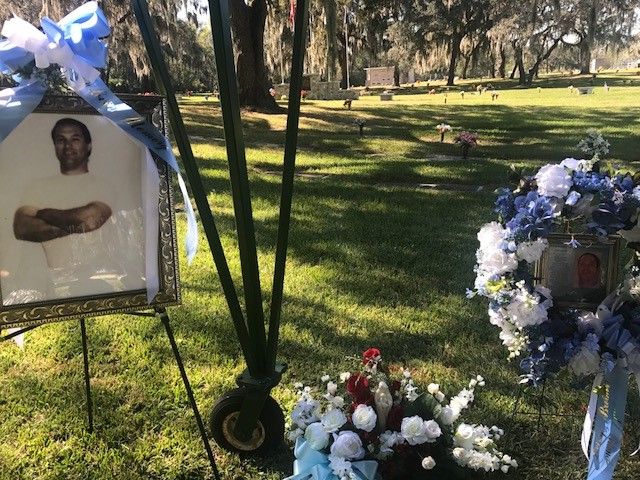
Once again, the state of Florida deliberately put a man to death by execution despite an unresolved claim of innocence. As has only become too common, the Florida courts simply refused to address the evidence supporting the claim that Robert Waterhouse was innocent before they too his life for a crime that Waterhouse may very well have been innocent off.
In January 1980 the nude body of Deborah Kammerer was found on the shore of Tampa Bay. It was obvious she died a violent death. But there was no eyewitness to the crime and nothing more than circumstantial evidence that perhaps she was in a bar the night before at the same time that Robert Waterhouse was there. The bartender claimed that Waterhouse talked to the victim and that they left the bar together. The policed immediately focused their investigation then on Waterhouse. He was taken into custody but never confessed to killing Deborah Kemmerer, only that he casually knew her from the bar. Police claimed that Waterhouse volunteered that he had experienced problems involving sexual activity, especially when drinking, and that he responded to his arrest by exclaiming that his life was over.
The police impounded Waterhouse’s car and claimed that a Liminol test revealed the presence of blood. The state got their expert to testify at trial that although they could not actually say that this blood was from the victim, it was generally consistent with the victim’s blood – and countless others. Several hairs were also found in Waterhouse’s vehicle and again the state produced an expert who told the jury although they could not prove it was the victims hair, it was consistent with her hair – and again, equally consistent with millions of other unknown people.
When Waterhouse was arrested in 1980 forensic DNA testing of blood and hair was not yet available. Such testing would have conclusively proven whether or not that blood and hair came from the victim. Years later when DNA became available and Florida adopted laws for allowing for DNA testing on earlier cases, Waterhouse was among the first who all but beat the courthouse doors down, demanding that this blood and hair be tested. Of course, the state of Florida fought tooth and nail to prevent this testing. Undoubtedly afraid that these DNA tests would prove that Waterhouse actually was innocent, the state lawyers advised the court that virtually all of that forensic evidence was “accidentally destroyed” due to a clerical error, even though applicable Florida law forbids the destruction of evidence in any capital case until the case becomes final and no further appeals can be pursued.
In May 2004 sixth Judicial Circuit Court judge R. Timothy Peters ordered a hearing on the state’s dubious claim that by coincidence virtually all of the forensic evidence that could have proven Waterhouse's innocent was destroyed. In this order Judge Peters specifically recognized that Waterhouse’s motion to compel DNA testing, which legally required a showing of innocence, was legally sufficient. But shortly following Judge Peter’s order for a hearing, the state prosecutor attempted to have Judge Peters removed and the hearing presided over by Judge Beach – the judge who had originally convicted and condemned Robert Waterhouse.
When judge Peters refused to step aside, the prosecutor filed an appeal to the Florida Supreme Court, asking that they stop Judge Peters from allowing any hearing on how and why all the evidence was destroyed, but the Florida Supreme court refused to stop the hearing. Although judge Peters was allowed to preside over the hearing, it was actually judge Beach who ultimately denied Waterhouse Waterhouse's appeal that that the destruction of the evidence violated his constitutional rights to a fair and meaningful opportunity to prove his innocence. In an unpublished order in October 2006 the Florida Supreme Court upheld the order rendered by Judge Beach. Why the Florida Supreme Court specifically ordered that its opinion denying his innocence claim not to be published, as all other decisions in capital cases are, remains a mystery – and the court will not explain its reasoning.
On January 4, 2012 Florida governor Rick Scott signed a death warrant against Waterhouse, scheduling his execution for February 16, 2012. Pursuant to Florida Rules of Criminal Procedures, only after a death warrant was signed were Waterhouse’s lawyers allowed to gain access to police and state agency files on the case. An ambiguity in one of the police reports compelled the lawyers to locate and talk to Leglio Sotolongo, who in the night of the crime worked as a doorman at the bar. To their surprise, Mr. Sotolongo remembered Robert Waterhouse and the events that took place that night of January 2, 1980, and he told them that he had told the police detective Cary Hitchcock that Waterhouse did not leave the bar that night with the victim Deborah Kammerer but rather had left with two men. Further, Mr. Sotolongo remembered that he also told detective Cary Hitchcock that the bartender Kyoe Ginn, who said she saw Waterhouse leave the bar with Deborah Kammerer was lying, as it would have been impossible for the bartender to actually see the door from where she was.
Under sworn oath, Mr. Sotolongo testified that rather than being interested in the truth, detective Hitchcock became angry and accused him and another bouncer (Leon Vasquez) of trying to help a murderer, even to the point of physical altercation in an attempt to coerce Mr. Sotolongo and Mr. Vasquez from telling that they had seen Waterhouse leave with two men and not the victim.
For over 30 years the police deliberately concealed this evidence and lied in police reports. When finally discovered that detective Hitchcock – who’s testimony was used to convict and condemn Waterhouse – had concealed Mr. Sotolongo’s statement and falsified police reports , the original trial concluded that since Mr. Sotolongo was not compelled to actively testify until over 30 years later, he was not a credible witness.
In a final appeal, Waterhouse’s lawyers attempted to stop the execution by arguing that execution of an inmate should be prohibited when the prisoner has maintained his innocence and it is shown that the state has destroyed evidence that may have proven his innocence. But once again, in a unanimous decision by the Florida Supreme Court, dated February 8, 2012, the court denied Waterhouse claims, denied relief and cleared the way for his execution.
Once again I am reminded of the public speech given by former Florida Supreme Court chief Justice Gerald Kogan shortly after his retirement in which he said” There is no question in my mind, and I can tell you this from having seen the dynamics of our criminal justice system over the years that I have been associated with it, as a prosecutor, defense attorney, trial judge, and Supreme Court Justice, that convinces me that we certainly have executed people who were, in fact, not guilty of the crime for which they have been executed”
America today remains the only western nation in the world that continues to use capital punishment, joining company with countries that America itself has long recognized as refusing to recognize basic human rights (Iran, North Korea, and China etc). With an average of well over 20,000 homicides occurring in America each year, and the vast majority of these convicted of murder having solid evidence of their guilt (such as eyewitnesses, forensic evidence, confessions etc) I ask you this – why is it that we see again and again those being put to death were convicted upon, what can fairly be described as, specious evidence, at best? Why is it that so many of those actually have substantial questions of actual innocence and evidence supporting their innocence, which the courts simply refuse to address and resolve? Shouldn’t there be a strict and inflexible rule of law that no person should be put to death if there is any question of whether they may be innocent? But contemporary, politically manipulated judicial systems have proven again and again that it lacks the moral character and ethical integrity required to protect the innocent from being executed.
Maybe everyone who claims to be innocent is not innocent, but without adequate safeguards to protect against the execution of the innocent by prohibiting the state from putting any person to death unless and until all questions of innocence are fully and fairly resolved, how can anyone say with any measure of moral certainty that we are not putting innocent people to death?
Michael Lambrix
#482053
Florida State Prison
Please check out my website http://www.southerninjustice.net
Showing posts with label innocent. Show all posts
Showing posts with label innocent. Show all posts
Monday, March 12, 2012

Monday, November 8, 2010
Screw the Truth – Execute the Innocent
Don’t you just hate it when inconvenient truths get in the way of killing people? Where do people get off thinking that carrying out executions has anything to do with such concepts as “truth and justice”? When it comes down to it, capital punishment is not about whether someone is guilty or actually innocent – it’s about the “politics of death” and feeding our twisted societies primitive need for vengeance. When a brutal crime occurs, we need to know someone will be held accountable and we are driven to find great satisfaction in knowing the crime has been avenged. That’s just human nature, and whether or not the person we ultimately put to death for the crime actually committed the crime really is not even relevant. The only thing that really matters is that we get our proverbial ‘pound of flesh”
In fact, we don’t even want to know that we may have executed an innocent man. Such an inconvenient truth completely undermines our fundamental need to believe in our judicial system. If we are forced to confront the truth then our own support for the death penalty makes us personally complicit in this morally and legally justified act of murder carried out in our name.
But most of us are good people of moral character and we would find it troubling that an innocent person was put to death for a crime he did not commit. We really don’t need to be weighted down by that moral baggage and so we choose to learn form the ostrich – we stick our heads in the sand and pretend it didn’t happen.
But the tragic truth is that it does happen and ignoring this truth won’t make it go away. By choosing to ignore the imperfection of our judicial system, we do become personally responsible for the execution of an innocent person. This truth can not be denied as if only more people would stand up and speak out against a system that refuses to admit its own mistakes then those we entrust to prosecute questionable cases will be forced to understand that both as individuals and as a civilized society, even the execution of one innocent person is not acceptable.
This past week, renowned bestselling author John Grisham released his latest book, entitled “The confession”. In this fictional story, Grisham writes of a 19 year old Donte Drumm, who found himself accused of the brutal murder of a local pretty young cheerleader in the small town of Slone, Texas.
Donte Drumm insisted that he is innocent – but what does innocence have to do with it? Without any real evidence, Drumm went straight to Texas death row. As the years pass, Drumm’s desperate appeals proclaiming his innocence are denied by one court after another and 8 years later Drumm finds himself facing imminent execution. Only then does the real killer have a crisis of conscience and comes forward to confess. But nobody wants to hear it. As we know only too well, prosecutors absolutely never admit they were wrong, and our courts never admit that a person might be innocent. Although innocent, Drumm never had a chance, as in our judicial system the puppet master would much rather execute an innocent person than to admit even the possibility of error.
This is not the first time Grisham wrote a bestselling book that tells the story of an innocent man being wrongly convicted and condemned to death, only to have evidence substantiating innocence deliberately ignored by the courts and the injustice intentionally perpetuated by the very people (judges and prosecutors) we trust to protect the innocent.
In John Grisham’s 2006 work, “The Innocent Man” Grisham told the true story of Ron Williamson, an aspiring high school athlete with a promising career ahead of him – until he suddenly found himself charged with capital murder in the state of Oklahoma and quickly convicted and condemned to death in spite of his innocence.
Only years later was DNA evidence discovered that not only proved Williamson was innocent but also revealed the true killer. But nobody wanted to hear it and both the prosecutor and the courts refused to admit that they could have made such a mistake. The only possible explanation was that either the DNA evidence had to be wrong, or maybe Williamson acted with this other person. To silence these claims of innocence, the state became that much more determined to expedite Williamson’s execution.
This is not at all surprising. For too long now this is how the American judicial system protects itself from having its mistakes exposed…they simply create new court rules and laws to limit post conviction appeals so that the evidence of innocence cannot be heard. By denying the wrongfully convicted any chance of proving their innocence, the errors are forever concealed.
Most recently this was the case in Texas when Cameron Todd Willingham was put to death. Willingham was convicted and condemned to death for allegedly setting fire to his own home, killing his own two young daughters. There were no eyewitnesses or confessions – but the local, small Texas town fire Marshall conducted his own investigation and concluded that the fire was deliberately set. This fire Marshall had no actual training in arson investigations, but that didn’t stop him from testifying in court that there was no question that the house was deliberately set on fire. To seal Willingham’s fate, the state brought in a prisoner from the local county jail who testified that Willingham told him that he had indeed set the house on fire to kill his two young daughters and did it to strike back at his wife after they had an argument.
Willingham insisted that he was innocent and that he didn’t know how the fire actually started. He testified that after seeing the smoke, he tried to get into the house to save his children, but couldn’t. The jury refused to believe him and court after court rejected his claim of innocence.
Shortly before Willingham was executed, some of the top arson investigators in the country were brought in to re-examine the case. Virtually every one of these experts concluded that the local fire Marshall was wrong and that the evidence showed that the fire was started by an electrical short – it was a tragic accident, and Willingham was innocent of murder as no murder occurred.
But the Texas courts didn’t want to hear it and refused to allow the evidence to be heard. Willingham was executed in 2004. Only after his execution did the evidence of his innocence catch the attention of the media, and the question of whether Texas executed an innocent man started to be taken seriously.
As the controversy build, Texas governor Perry formed a panel of experts to finally review the evidence to determine whether Willingham was innocent. This “commission on forensic science” thoroughly studied the evidence and reached the inconvenient conclusion that Willingham was innocent – that the State of Texas had deliberately put an innocent man to death.
But it was an election year and Perry was running for re-election. In Texas the death penalty is all about politics and you cannot win an election by seeming soft on convicted murderers or admitting you made a mistake. Using the power of his office, shortly before the Texas “commission on forensic science” was to public ally release its report declaring Willingham innocent, Governor Perry abruptly fired the panel and appointed his own hand picked political insiders. Once again, the inconvenient truth of innocence was suppressed by the insidious politics of death.
In John Grisham’s book “The Confession” he writes that “death row is a nightmare for serial killers and ax murderers – but for an innocent man, it’s a life of mental torture that the human spirit is not equipped to survive”
I know only too well of the eternal mental anguish of being a condemned man, convicted and sentenced to death for a crime I did not commit. In my main website, www.southerninjustice.net my supporters have posted my entire case – complete trial transcripts, appeal briefs, etc and the evidence supporting my actual innocence.
In my recently published book “To Live and Die on Death Row” by C Michael Lambrix (available online for free at www.lulu.com) I graphically detail what life is like on death row, the never ending torment of being in solitary confinement for over 27 years and the relentless struggle to maintain my sanity as one court after another refuses to even hear the wealth of evidence substantiating my innocence, see also my secondary blog, www.doinglifeondeathrow.blogspot.com.
The past month my lawyers filed a “last ditch” appeal to the United States Supreme Court arguing specifically that they must order the lower courts to allow my evidence of innocence to be heard – or I will be executed for a crime I did not commit. But will the Supreme Court even listen? I can only hope they will. You can personally read this recently filed appeal at www.supremecourtinnocenceappeal.blogspot.com
But my faith in our judicial system to protect the innocent and even in the nature of humanity in general is suffering. If I have learned nothing else over the many years, it is that too many feel “screw the truth – just execute the innocent”
Please check out my website http://www.southerninjustice.net
Subscribe to:
Posts (Atom)