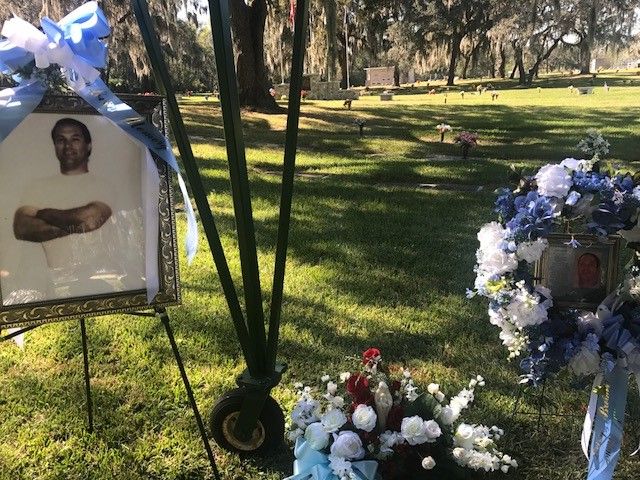
Written by Mike in January, 2009
There’s a song I recall from many, many moons ago in a life now far,
far away ~ the words still haunt me from time to time, and I smile…
“Once was the thought inside my head, before I reach 30 I’ll be dead…”
At 48 years old now. I’ve spent almost my entire adult life in a
solitary cage on Florida’s death row. Doing life on death row isn’t
about living at all, but about dying slow, a day at a time. If there’s
anything even harder than living alone, it’s got to be dying alone, as I
only exist in a very small world where death is the only absolute
reality and everything else is just part of that path getting there.
But
there’s many kinds of deaths ~ there’s the death of the body and the
death of the soul. There’s a point man can reach when even physical
death is seen as a blessing, as a means in which to end a nightmare that
has no end. I remain alive only because I still have the strength
within me to cling desperately to the remnants of hope that pass my way.
But perhaps hope is the greatest deception of all ~and the loss of hope
the cruelest death. I’ve seen it only too often, men I’ve know for
years slowly broken down by the existence in this artificial environment
until you can see it in their eyes ~ that dull look that means only one
thing… they’ve given up hope and now await the fate of the condemned, a
fate that ultimately becomes more of a mercy killing than an execution,
as that physical death brings with it the promise of freedom from a
fate far worse than death itself.
That’s what doing life on death
row really is ~ it’s a fate worse than death. It’s being condemned not
merely to death, but the torturous, methodical degradation of one’s
humanity in a world designed to first break you down and make you
something less than human before they finally strap that broken flesh to
a cold chair or gurney and ritualistically terminate your existence. In
truth, most of those ultimately executed at the hands of the state have
already given up the ghost long before and have embraced death as the
end of a long journey through a hell few could begin to imagine.
Hanging On To Hope
Each
month all of us receive a slip of paper that advises us of any “gain
time” we might have received that previous month. By law, the prison
officials are required to do this, as well as provide the prisoners
“presumptive release date” recalculated each month to reflect the
deduction of any gain time that might have been awarded.
Every
prisoner on Florida’s death row has a presumptive release date in the
year 9999. That gives me only, 7992 years yet to go before my presently
scheduled release and I’m already counting it down one day at a time.
I’ve read in the Bible that Methuselah lived to the ripe young age of
969 years and that was thousands of years ago. So, with modern medical
breakthroughs extending the average lifespan I figure I’ve got a good
shot at it… all I’ve got to do is live to be at least 8,039 years old
and then I’ll walk out the front gate a free man.
This is the kind
of humorous “hope” that we cling on to. When these slips of paper are
passed out each month, inevitably someone on the wing will holler out,
“Hallelujah, baby ~ I’m coming home!” or just as often one guy hollering
down the row for all to hear, “Pack your sh__, Bubba, they’re throwing
you out.” And some laugh.
A lot of us talk about going home and in
that stolen moment of fantasy we can see the green, green grass of
home. For some, this hopeful fantasy evolves into a form of psychosis
and they not only believe they’re soon going home, but know the exact
date and when that date approaches they even give away their personal
belongings and awake that particular morning and await the guards to
escort them to the front gate. Reality is nothing more than what any of
us chose to perceive it to be, and in their own little corner of their
own little world , that’s their reality and in a way I truly do envy
them as I remain trapped in my reality.
Through the years many
have gone home, having proven before the courts that they were
wrongfully convicted and upon that legal exoneration they won their
freedom. There’s been more than I can remember, but knowing that there
have been so many is, itself, a form of hope.
About five years ago
or better a long time friend of mine, Juan Melendez, known
affectionately to us as “Puerto Rican Johnny” was on the floor I was on.
Johnny and I had lived in the same area out on the streets and we would
often talk about places and even people we both knew. Johnny would show
me pictures of the house he grew up in, of his elderly mother, and talk
about how when he got out he would return home and take care of his
mother.
Just before Christmas back then he got word that the lower
state court threw out his convictions, recognizing that the state had
illegally withheld exculpatory evidence. Mucho Macho Johnny cried that
night and in our own way we all shared a tear with him. In the sixteen
years that he lived among us, he became our brother. Then a few weeks
after Christmas the warden came up on the floor and told Johnny to get
his stuff as they were releasing him that day. Johnny’s cell was down
towards the end of the hall and as he passed he spoke to each of us
momentarily. As Johnny approached my cell I felt only joy ~ sharing his
joy ~ as he told me, “Rum and coke, esso” … remembering our promise to
have a drink in the free world . And then he was gone, but a part of
each one of us walked out that front gate back into the free world with
him.
Hope… yet another four letter word, a mistress that can and
gladly will deceive and seduce you with her elusive charms. It’s that
whisper of a promise that your time there will come too, that gives a
man the strength to keep that hope alive. But when hope fails then that
mistress can become the Angel of death as that lost hope becomes nothing
more than the desperate last act at the end of the rope. And there are
few things more despairing than to watch helplessly as the guards rush
into a cell in the middle of the night and can be heard cutting a man
down, then moments later passing by your cell with the cold body of
someone you knew and lived among for years.
Rotting Away One Day At A TimeWhile
hope is a stolen luxury that brings with it a fragile strength, death
continues to be a reality that cannot be denied. For too many of us now
doing life on death row this condemnation is about slowly growing old
and rotting away until death claims us not at the hands of an
executioner, but by “natural causes.”
Although I have now been on
death row almost a quarter of a century, there are many who have been
here much, much longer. After the Supreme Court threw out the death
penalty in Furman v. Georgia (1972) Florida was the first state to rush
newly written laws into effect to allow the continued use of capital
punishment. Although these new laws didn’t pass constitutional challenge
until 1976 in Proffit v. Florida, many of the men still on Florida’s
death row today have been here since at least 1974.
When I was
charged with the capital murder case that brought me here, I was 22
years old. Recently divorced at the time, I had three young children; my
youngest barely a year old.
Mike shortly before being incarcerated
I look in my mirror today and it’s hard to
see that young man I once was, as the face looking back is that of a
grandfather. My full head of hair is long gone and what hasn’t fallen
out is turning gray.
Mike in 2009
I am not alone. Death by default that’s what
it is. Too often when morally corrupt prosecutors know they cannot kill
you, they will maliciously drag your case out until you simply die of
old age. Under any circumstances living in solitary confinement under
the stress of being condemned to death takes its toll upon the physical
and mental health of even the strongest men.
Inevitably, we all
grow old, and again, death is the only absolute reality. In a way I
should consider myself lucky as at least I came to the row while still a
young man. There are many more significantly older when they arrived
and the years living in a cage were not as easy. For every man executed
in the past 30 years, there’s been at least one other slowly rotting
away and inevitably dying of old age.
I read recently in the past
10 years alone at least 30 men have died of “natural causes” on
Florida’s death row. Some were of old age ~ others of various types of
cancer… many I personally knew. With so many here now for well over 25
and even 30 years, death row is growing gray. At the front of each death
row floor there is a handicapped cell intended to house the many who
are already confined to wheelchairs. More than a few are now over 75 and
will almost certainly slowly rot away and die in their cell as even if
they lost all their appeals the governor would not sign a death warrant
on them as it’s politically incorrect to put an old, physically disabled
man to death ~ but it’s perfectly acceptable to, instead, let him rot
away until he eventually dies.
In some cases this is actually by
intent and purpose. I know at least a few here today who have lost touch
with reality and if ever scheduled for execution the courts would be
forced to reduce their sentence to life as it’s constitutionally
prohibited to execute a person who has become legally insane. It’s also
politically unacceptable to recognize their insanity and reduce their
sentences to life. So that they can be transferred to a prison
psychiatric unit and receive proper care. The solution is to simply
ignore them ~ to deliberately let them rot away until they die in that
cage. Inevitably they do… they always do.
But nobody cares. When
was the last time you saw any newspaper talk about the many on death
rows growing old and dying alone? Recently a national debate about the
constitutionality of using lethal injection as a means of carrying out
executions generated substantial media interest after Angel “Popo” Diaz
was allegedly “tortured” to death by a botched execution and witnesses
said it took at least 24 minutes to kill him…. 24 minutes.
But
what of the many more who are slowly dying in their cells? If prolonging
a man’s death for 24 minutes constitutes cruel and unusual punishment,
then why can’t it also be argued that allowing a man to slowly rot away
in solitary confinement for many decades until he dies is also cruel and
unusual? As a presumably civilized society we are ultimately defined by
the measure of humanity we show to others and yet nothing personifies
that malignant evil within the heart of man than by looking at the
inhumanity we so deliberately inflict upon the least of the least ~ and
nothing in our contemporary society illustrates this truth better than
the deliberate deprivation imposed upon the condemned ~ it’s not enough
to want to take our lives, society demands that we must also suffer
until we are slowly broken and then ~ for those who are lucky ~
something less than human is put to death.
From Cockroaches and Rodents to Rats and Snakes
When
I first came to death row in March of 1984 this was a much different
place ~ not only physically, but the mentality was different. At that
time Florida’s main death row was at Florida State Prison, long infamous
as the end of the line, where prisoners were warehoused when they could
not be securely kept elsewhere. Physically, the wings housing death row
were comparable to Third World living conditions. In the winter we
froze and in the summer we boiled. With “open wings” (the interior of
the wings open from the first tier all the way up to the third tier) it
was noisy, as a hundred men would be yelling or watching TV or whatever.
With no screens on the always broken windows, the wings were quite
literally infested with cockroaches, rodents, even snakes, and birds ~
and then there were many wild cats that would come in to feed off the
mice and rats.
But as bad as the physical conditions were it was a
better place. In 1992 they built and opened a new building designed
exclusively to house death row. Soon after the majority of the over 300
condemned were transferred to this “Northeast Unit” of the Union
Correctional Institution. As I write this I can look outside the window
on the catwalk and in the distance I can see the Florida State Prison ~
so close, and yet so far away.
At “FSP,” as we call it, there was a
unity ~ even a “brotherhood” ~ that tied us all together. We lived in
close proximity to each other and looked out for each other. If a guard
came down and screwed with one of us without cause, he took on the whole
wing. Although there were always a few assholes and idiots on both
sides of the bars, most of us looked out for each other. Back then you
knew the difference between a convict and an inmate and a
correctional officer and a guard ~ and there is a world of
difference. A convict is a stand up guy whose word is his bond and he
knew enough to mind his own business and keep his mouth shut when he
didn’t know something for a fact. An inmate was seen as a prison rat;
the lowest form of life; worthy of no respect. An inmate was by nature
unworthy of respect, he was the kind of guy who would lie, gossip, and
backstab even his own best friend; often for no reason at all. Inmates
were rare on death row back then.
Equally so, the difference
between a corrections officer (known only as an “officer”) and a guard
was like night and day. An officer came in to work his eight hours and
go home ~ it’s just a job and he wasn’t going to take it personally. An
officer had no personal malice towards the prisoners and didn’t go out
of his way to provoke anyone. If he came in to do a cell search
(“shakedown”) he did it without maliciously destroying your property and
didn’t have to prove his manhood by being a jerk. Although avoided as
much as possible, officers were respected ~ guards were not.
A
guard was commonly referred to as inbred redneck scum, the kind of guy
who got the job because he couldn’t work anywhere else. A guard didn’t
just work eight hours ~ he lived the job and it ate him away like a
cancer until all that was left was a bitter broken man who went out of
his way to make everyone else miserable. He has malice in his heart and
was looked upon with nothing less than contempt, not only by prisoners,
but the officers who respected their job.
In those early years a
man was allowed to do his own time. In the early 80’s we had only just
began to see politicians begin to campaign on promises to lock up more
people and make sure prisoners did “hard time.” Although physically our
environment was deplorable, we would all gladly go beck if we could have
all our privileges returned. Back then we had packages sent in from
family and friends four times a year with personal clothes, shoes,
cosmetics, maybe even a decent watch or ring and a nice radio. We were
allowed to receive “hobby craft” packages monthly with materials for
painting, crocheting, and all sorts of other stuff. All of that is long
gone now ~ nothing comes in from the outside world anymore and anything
we might get must be bought from the prison store at significantly
marked up prices; the profits used to subsidize our incarceration, as
the prison system has become a virtual industry with thousands of
companies now dependant upon contracts they receive to provide
everything from the food we eat to the toilet paper we wipe our asses
with. It’s all about politics now.
Death row has changed, in every
conceivable way. No longer is a man able to do his own time and mind
his own business. A new generation has taken over and even so many of
the old timer “convicts” are now nothing more than inmates themselves.
Because of this death row has become hard time as now not only do we
live in a much more deliberately segregated building with only 14 men on
each closed run, but you learn to keep to yourself as the man you call a
friend today will only too quickly backstab you tomorrow. Respect means
nothing in this new generation. And it’s become a much lonelier place.
Watching the World Slip AwayI
see that outside world only through the very limited media I’m allowed…
a small TV, which the powers that be have determines necessary to
prevent against insanity ~ if I were to go insane, then they could not
kill me. A small “walkman” type battery powered radio, that doesn’t pick
up any stations, and a few magazines and newspapers.
In my world
there are no computers, no cell phones, and none of the electronic
conveniences that most people take for granted. In the past 24 years I
have not touched dirt or grass as our small fenced yard is nothing more
than a concrete pad between two wings. I sometimes wonder if the moon
and stars still exist as I haven’t seen the night sky in so many years
it becomes hard to even remember it.
The deprivation of material
those material things that most people simply take for granted out there
in the real world certainly pale in comparison to those things that
really do matter; especially in this world ~ those things that once
separated make it seem that we are helplessly watching the world slowly
slipping away.
It is the nature of prison to alienate a man from
those he loves. For most, with very few exceptions, as the years pass
the few family and friends that once stood by slowly drift away and move
on with their own lives. Through the years I can count on the fingers
of a single hand the number of death row prisoners who have had family
consistently stand by them. Friends tend to drift away even quicker.
That’s
not to say they deliberately abandon those they love at the time they
need them most. I’d like to believe that most of our families and
friends never intended to abandon any of us, but simply moved on and we
became less and less of their lives. I’m personally blessed with a large
family but haven’t had any communication at all with most of them for
many, many years. Life out there in the real world doesn’t come to a
stop just because we are no longer in it and as time takes its toll the
distance becomes greater and before you know it you’re no longer part of
their lives. That’s just the reality of doing time. Accepting that
reality doesn’t make it any easier and many in here do turn cold and
bitter as they’re abandoned by those who mean the most.
Most of us
learn early on not to count on anyone other than ourselves. Contrary to
a popular myth the prison doesn’t provide all our needs ~ at best, it
provides only the absolute minimum and even then does so in such a way
that encourages ~ if not coerces ~ each prisoner to actually purchase
even the basic necessities from the prison store, as with each purchase
the prison makes a substantial profit.
Without a friend or two
outside willing to help prisoners ~ especially those on death row ~ can
become even worse than what might be imagined. At least in general
population most prisoners can work a job and “hustle” for what they need
through a long established barter system. Death row prisoners are not
allowed to work a job and have no means in which to barter ~ our only
means of survival with minimal comfort is through the compassion and
generosity of those who care about us.
As family and friends tend
to drift away we are forced to try and reach out to new friends and
establish new ties with that outside world. But there are many who hold
nothing but malice in their hearts towards prisoners ~ especially death
row prisoners ~ and have exerted political pressure to pass laws that
now prohibit prisoners from placing personal ads that might allow them
to meet new friends, perhaps even a girlfriend who might want to visit.
Florida
is unique in the country in implementing these draconian rules
prohibiting prisoners from attempting to meet new friends and the result
can be seen ~ more and more. Those of us who have been here the longest
are increasingly isolated from the free world; effectively abandoned
and left to die alone. More and more I see strong men break down and
give up, unwilling to have to beg their neighbors for a simple cup of
coffee or bar of soap and slowly retreating into his own world of self
consuming bitterness and anger and a fate far worse than death.
When
it comes down to it, that’s what doing life on death row is really all
about… it’s not about living, but about dying one slow day at a time.
It’s about simply existing in a solitary concrete crypt. Increasingly
isolated from all that really matters, of being methodically deprived of
the most basic elements that make us human ~ companionship, compassion,
and hope, as hope itself is dependent upon a reason to live.
As I
am increasingly isolated from all that matters, that hope and will to
live continues to erode ~ I’m not doing life on death row … I’m simply
waiting to make my death final.
Mike Lambrix
Mike's website: Southern Injustice
Friday, June 29, 2018
Tuesday, April 17, 2018
Execution Day – Involuntary Witness to Murder
The PEN Prison Writing Contest just released the winners for the 2017-18 contest and Mike placed third in the essay category with this essay.
Written for MinutesBeforeSix
As if a scene straight out of The Twilight Zone, circumstances trapped
me within the cold and calculated process that resulted in the murder by
state sanctioned execution of Oscar Ray Bolin on January 7, 2016. In
all the years I´ve been on Florida´s death row, I´ve never been in such
close proximity to an execution as it unfolded around me, forcing me to
become part of the very process that they intended to then subject me to
in precisely five weeks’ time.
On November 30, 2015, Florida Governor Rick Scott signed my death
warrant and I was immediately transferred from the main death row unit
at Union Correctional (less than a mile away) to the “death watch”
housing area on the bottom floor of Q-Wing at Florida State Prison. I
joined Oscar down there—his own death warrant had been signed about 5
weeks earlier and they intended to murder him on January 7. There are
only three cells in the death watch area, and Oscar was in cell one, and
I was place in cell three, with an empty cell separating us.
Through those five weeks, each day brought him closer—his wife of almost
twenty years solidly by his side, uncompromised in her commitment to
stand by him and prove that he was innocent. And those familiar with the
case knew that recently developed evidence did establish a persuasive
issue of innocence, too.
His final rounds of appeals focused specifically on evidence supporting
his innocence and the hope that the courts would do the right thing. As
the New Year weekend passed, the Federal District Court summarily denied
review of his innocence claim upon the finding that the lower Federal
Court didn´t have jurisdiction to hear his claim of innocence. But there
was hope, as the District Court granted a “Certificate of
Appealability” (“C.O.A.”) authorizing appellate review before the
Eleventh Circuit, and soon after the Eleventh Circuit issued an order
establishing a “briefing schedule” in March…it seemed all but certain
that Oscar would be granted a stay of execution and his claim of
innocence would be fully briefed and heard by the appellate court.
Monday, January 4 passed as he anxiously awaited word that a stay of
execution would be granted, but there was only silence from the court.
Each day his wife spent every minute she could and it is impossible to
imagine the pain she felt—she too was unquestionably a victim caught up
in this cold process that unfolded around her.
I sat in my solitary cell not more than ten feet away and found myself
impressed with the strength Oscar exhibited, and the concern he held for
his wife and what this process inflicted on her. Society wanted to
label this man a cold-blooded killer, yet if only those only too willing
to throw stones could see the desperate concern he had for his wife,
they could see how wrong they are.
Now I struggle to find the words—and with a reluctance to even write
about what I involuntarily witnessed. But if I don´t, then who will? And
is it really fair that the record of what transpired would otherwise be
the state´s own version, leaving no perspective from those that they
kill?
I must emphasize that even as much as these events impacted me due to my
close proximity to this process, it is not comparable to what they were
forced to endure, and the loss those who loved Oscar Bolin suffered. My
attempt to share what transpired from my own unique perspective is done
in the hope that perhaps by bearing witness, others would see just how
incomprehensibly inhuman this process is, and how truly cold-blooded
this act of murder is…and to know it is carried out in all of our names.
And I apologize for rambling on—it is not easy for me to find the
necessary words. I can only hope that I can convey the true impact of
what unfolded and compel those that read this to ask themselves whether
this truly is what we aspire our society to be? It´s easy to justify the
death penalty by claiming that it is in the interest of justice to kill
those convicted of killing another—to become a killer ourselves.
But how many give a thought at all to just how much contemplation is put
into this process employed to take that life? I am again reminded of
what I once read, written by the philosopher Frederick Nietzsche,
“Beware that, when fighting monsters, you yourself do not become a
monster.”
Think about that. It´s easy to dismiss what I say by blindly insisting
that a jury convicted Oscar Bolin of murder and that justice demands
that society take his life. But really—who is actually investing more
conscious thought into the act of taking a human life?
It is for this reason I´m determined to share my own unique perspective
of what this process is, and how by these very actions it reduces
society itself to that very level of becoming “the monster.” Perhaps in
my attempt to share this, others can see just how wrong this is.
On the early morning of Monday, January 4, the day began with the death
watch staff advising both me and Oscar of our scheduled visits and phone
calls for that day, I had already asked my family and friends not to
visit that week as I didn´t want my visits to interfere in any way with
Oscar´s visits. All I had was a phone call from my son early that
morning and a legal phone call with my lawyer later that day.
Oscar had a visit with his wife and both anxiously awaited any word from
the Eleventh Circuit courts hoping that a full stay of execution would
come and the court would allow full and fair review of his innocence
claim. But the day passed without any word from the court. By that
evening Bolin was down to 72 hours—and I know from personal experience
how difficult that was, as I had come within hours of execution myself
when I was on death watch years earlier—only I was granted a stay.
By Tuesday morning, January 5, Oscar was down to sixty hours, and the
clock continued to tick away and yet still nothing from the courts on
whether they would allow his claim of innocence to be heard. Oscar spent
from late morning until mid-afternoon with his wife in the non-contact
visiting area. Upon his return, his demeanor was more subdued and the
stress and anxiety he felt became all but tangible. And as I sat
silently a few feet away in my own solitary cell, I wondered whether any
of those willing to take his life gave even so much as a moment of
thought into what they were inflicting upon other human beings—and
again, Oscar was not the only one forced to count down those final hours
anxiously hoping that phone would ring with the news that the court
would allow his claim of innocence to be heard…every second of every
moment, every hour that passed inflicted incomprehensible pain upon his
wife and those that cared for him.
That evening passed in an uncomfortable silence as the courts would have
closed their doors for the night and no news would come until at least
that next morning. That psychological trauma of uncertainty weighed
heavily upon them.
I doubt Oscar slept much that Tuesday night—I know I didn´t. His T.V.
remained on into the early morning hours. By that next morning
(Wednesday) he was down to about thirty six hours until his still
scheduled execution and still no word from the court. It would be a long
day. They brought the breakfast trays as they did each morning, but
neither of us had any interest in eating. Down here on death watch, our
meals are kept under direct supervision of security staff to ensure
nobody (other prisoners or staff) has any chance of tampering with the
food or smuggling anything to the condemned prisoner.
This methodical countdown to the intended execution actually starts a
full week before, when they remove all personal property from the
condemned prisoner´s cell, placing him (or her) on “Phase II.” From the
moment they place the condemned prisoner on Phase II (that final week) a
guard is posted directly in front of the cell twenty four hours a day,
his only job to observe the condemned prisoner to ensure he (or she)
doesn´t attempt suicide or harm themselves—and a few have tried. Any
activity is written in a forest green “Death Watch Log.” Throughout this
time, not even for one second are you allowed to forget that they are
counting down your last days—and last hours.
Oscar again had a visit with his wife as she stood faithfully by him
spending every moment she could—even if those visits were restricted to a
few hours of non-contact (through glass) visits.
By early afternoon Oscar returned to his death watch cell—still no word
from the court. The hours dragged by as Oscar talked to the guard
stationed in front of his cell, simply talking about anything at all.
Warden Palmer came down, accompanied by Deputy Secretary Dixon (the
second highest Department of Corrections employee). They talked to Oscar
for a while mostly just to check on how he was holding up. But the
preparations had begun and that final twenty four hours was quickly
approaching. After they talked to Oscar, they stepped that few feet
further down to the front of my cell and spoke to me.
I must admit that I was impressed by their professionalism and their
sincerity that bordered on genuine concern. Perhaps the most heard
expression on death watch is an almost apologetic “we´re just doing our
job” and the truth is that the current staff assigned to work the death
watch area and interact with the condemned prisoners counting down their
final hours do go to great lengths to treat us with a sense of dignity
and respect seldom even seen in the prison system.
The significance of this cannot be understated. I´ve been down here on
death watch before years ago and came within hours of being executed
myself, and there´s always been a deliberate distance between the
condemned and the staff—especially the higher ranking staff. But it´s
different this time. In the five weeks that I´ve been down here almost
daily high ranking staff have come down to the death watch housing area
and made a point of talking to us in an informal manner, abandoning that
implicit wall of separation between them and us.
And now none other than the Deputy Secretary himself personally came
down to talk to us—I´ve never heard of this before. Shortly after they
left, Oscar asked the sergeant for the barber clippers. He wanted to
shave his own chest and legs, rather than have them do it the next day.
It had to be done, as the lethal injection process requires the
attachment of heart monitors and Oscar preferred to shave it himself—as
most would.
Oscar received another legal phone call later that afternoon—now down to
almost twenty four hours until his scheduled execution and still no
decision by the Eleventh Circuit as to whether or not they´d allow
review of his innocence claim. The lawyers would call if any news came,
but it was assumed that the judges deciding his fate already called it a
day and went home. No further phone call came that night. Again Oscar
stayed up late, unable to sleep until sometime in the early morning
hours and he was not alone, as sleep would be hard to come by.
We reached the day of execution. Typically, they change shifts at 6:00
a.m. working a full twelve hour shift. But on days of scheduled
execution, they change shifts at 4:30 a.m., as with the execution
scheduled at 6:00 p.m. they cannot do a shift change then, as the entire
institution will go on lockdown during that time.
With that final twenty four hours now counting down, each minute was
managed by strict “Execution Day” protocol, and the day started earlier
than usual. As if an invisible cloud hung in the air, you could all but
feel the weight of this day as it was that tangible, and undoubtedly
more so on Oscar. But he was holding up remarkably well, maintaining his
composure even though the strain was obvious in his voice. How does one
go about the day that they know they are to die? Again, I´ve been there
myself and I know how he felt and it cannot easily be put into words.
Oscar was diabetic and as with each morning, the nurse came to check his
blood sugar level and administer insulin, if necessary. Now within that
final twelve hours, nothing would be left to chance. Around 7:00 a.m.,
they let Oscar take a shower, and then after locking down the entire
institution, they took him up front for a last visit with his wife. They
would be allowed a two hour non-contact visit until 10:00 a.m., then an
additional one hour contact visit—the last visit before the scheduled
execution.
Shortly after 11:00 a.m. they escorted Oscar back to the Q-Wing death
watch cell. A few minutes later “Brother Dale” Recinella was allowed to
come down and spend a few hours with Oscar as his designated spiritual
advisor. Contrary to the Hollywood movies depicting the execution
process, the prison chaplain is rarely, if ever, involved as each of us
are allowed to have our own religious representative—and many choose
“Brother Dale” as he is well-known and respected amongst the death row
population.
Many years ago Brother Dale was a very successful lawyer, making more
money than most can dream of. But then he experienced a life-changing
event and spiritual transformation, as chronicled in his book “And I
Walk on Death Row”.
Brother Dale and his equally-devoted wife Susan gave up their wealth
and privilege and devoted their lives to their faith and ministering to
death row.
Even as these final hours continued to count down, I remained in that solitary cell only a few feet away and unable to escape the events as the continued to unfold around me. There are only three cells on death watch and I found it odd that they kept me down here as they proceeded with this final process—when I was on death watch in 1988, they moved me upstairs to another cell removed from the death watch area as they didn´t want any other prisoners in the death watch area as these final events unfolded.
Brother Dale left about 2:00 p.m. and the death watch lieutenant, a
familiar presence on death watch, then made a point of talking to Oscar
and they went over the protocol—shortly before 4:00 p.m. he would shower
again and then be brought around to the west side of the wing where
they had only one cell immediately adjacent to the door that led to the
execution chamber. I listened as this process was explained, knowing
only too well that in precisely five more weeks I would be given the
same talk.
The warden and Asst. warden came down again and talked to Oscar. A few
minutes later the Secretary (director) of the Florida Department of
Corrections, Julie Jones, personally came to Oscar´s cell and sat in a
chair and talked to him—I´ve never heard of that happening before. But
her tone of voice and mannerisms reflected genuine empathy towards
Oscar, and he thanked her for taking that time to talk to him.
As they now closed in on that final two hours before the scheduled
execution, Oscar received another phone call from his lawyer—the
Eleventh Circuit Court of Appeals still had not ruled on whether they
would grant a stay of execution and allow a full review of his pled
innocence claim. Oscar´s voice was obviously stressed. Per protocol, the
nurse gave him 5 mg. valium to calm his nerves.
Just before 4:00 p.m., Oscar spoke to me, wanting to talk about a
problem he and I had years ago—a problem that I alone was responsible
for and of which I have often regretted. In the five weeks we had been
on death watch together, it was not spoken of. But now, to my amazement,
even dealing with all that he was dealing with, Oscar wanted me to know
that he forgave me for what I did. And for a few minutes we talked. And
then the warden and his staff removed Oscar from his cell and escorted
him around to the west side of the wing, to the execution chamber
holding cell, where he would remain until the court cleared the way for
execution, or he received a stay of execution and was brought back to
this side.
A single sergeant remained on this side, and for the first time since I
was brought to death watch I was alone as the sergeant remained at the
desk just outside the cell block area—and I didn´t want to be alone. As I
do often, especially when stressed, I paced in my cell anxious to hear
any word on what was going on and checking my watch almost every minute,
and each minute dragged by so slowly it was almost as if time itself
had stopped and I couldn´t begin to imagine what Oscar and his wife were
going through.
At irregular intervals the sergeant would walk down to my cell to check
on me and I asked whether there was any more news. The Eleventh Circuit
had denied his appeal and the case quickly moved on to the U.S. Supreme
Court. The designated time of scheduled execution—6:00 p.m.—came and
went without any word from the Supreme Court.
Oscar would remain in that holding cell until the Supreme Court cleared
the way for execution—but at least both he and his loved ones still had
hope as the minutes continued to tick away.
Most don´t realize just how many people are involved in this execution
process and everybody remained on hold not knowing whether the execution
would proceed or not. Immediately adjacent to my cell was a solid steel
door that led directly into a hallway stretching the entire width of
the wing. Just inside this door was an area with a coffee pot and
chairs, and I could hear a number of unknown people congregated only a
few feet away from me on the other side of the door as they discussed
the continued uncertainty.
A larger crowd of unknown participants congregated on the lower
quarter-deck area between the west side of the wing where the death
watch housing area was and the door that led into the east side where
Oscar remained in the holding cell. I couldn´t make out what they were
saying and wondered, especially when I periodically heard laughter. I
suppose this long wait was stressful on them, too, and a moment of
levity could be forgiven. And yet I found myself wondering what they
could possibly find funny as they awaited that moment of time when they
would each assume their assigned task and take the life of another human
being.
One hour passed, and then another, and another yet. Then at almost 10:00
p.m. it suddenly got quiet—very quiet. All the voices that continuously
hummed both behind that steel door and the quarter-deck area just
suddenly went silent and without anyone around to tell me; I knew that
they all moved to their positions in the execution chamber.
Vigil Oscar Bolin
Vigil Oscar Bolin
It remained utterly silent—so quiet that I could hear the coffee pot
percolating at the sergeant´s desk on the other side of the gate and I
held my watch as the minutes passed and I strained to hear any sound at
all. But there was nothing and I knew they were now putting Oscar to
death. I cannot explain it, but I just felt it—and I got on my knees and
I prayed, and yet I couldn´t find any words and found myself kneeling
at my bunk in silence for several minutes.
Then I heard what sounded like a door on the other side of that concrete
wall that separated my cell from the execution chamber. Then I once
again heard muffled voices on the other side of that steel door. It was
over and it went quickly…Oscar was dead. A few minutes later I heard the
sound of a number of people going up the stairs leading away from the
execution chamber. Their job was done and in an orderly manner they were
leaving.
For obvious reasons, I didn´t sleep that night. Only a few feet behind
that wall of my cell, Oscar´s body now lay growing cold. There are no
words that can describe how I felt, but that emptiness that consumed me
and left me laying in my bunk in complete silence through the night.
Somewhere in the early morning hours I fell asleep, only to awaken just
after 7:00 a.m. It was a new day. The death watch Lieutenant was already
here and I was now the only one left on death watch. But just that
quickly, I was instructed that I had to immediately pack my property as
they had to move me to cell one—the cell that Oscar only recently
vacated.
I didn´t want to move to that cell, but I didn´t have any choice. That
was the same cell I previously occupied in late 1988 when I myself came
within hours of my own execution (read, “The Day God Died”)
and especially knowing that only a few hours again Oscar was in that
cell still alive and holding on to hope, I just didn´t want to be moved
to that cell. Every person who has been executed in the State of Florida
in the past forty years was housed in that cell prior to their
execution.
But it wasn´t a choice and I obediently packed my property and with the
officer´s assistance, I was moved from cell three to cell one. And as I
worked on putting all my property back where it belonged (storing it in
the single steel footlocker bolted firmly to the floor), a long-awaited
phone call from my close friend Jan Arriens came through.
While on death watch, we are allowed two personal phone calls each week,
and since my warrant was signed five weeks earlier, I had anxiously
awaited the opportunity to talk to Jan, but through the Christmas
holiday he was visiting his family in Australia. Having only recently
returned to his home in England, he arranged this phone call.
It was good to hear a friendly voice just at that time when I most
especially needed a friend. But we only had a few minutes to talk and
unlike those eternal moments of the night before, these minutes passed
far too quickly. But just hearing the voice of a friend comforted me.
Shortly after that phone call, I then had a legal visit and was escorted
to the front of the prison to meet with my lawyer´s investigator. We
spent hours going over legal issues and then it was back to the death
watch cell. Not long after I returned, I learned that the governor had
already signed another death warrant. This machinery of death continued
to roll along. By mid-afternoon a familiar face was brought down to join
me…Mark Asay (who we call “Catfish”) had his death warrant signed that
morning, with his execution scheduled for March 17, exactly 5 weeks
after my own scheduled execution.
With the methodical precision of a mechanical machine, Florida has
resumed executions with a vengeance, establishing a predictable pattern
of signing a new death warrant even before the body of the last executed
prisoner has grown cold.
Now I remain in the infamous “cell one,” next in line to be executed—and
on February 11, 2016 at 6:00 p.m., the State of Florida plans to kill
me. Until then, I will remain in a cell in which the last twenty three
occupants, without exception, resided until their own execution. I do
not like being in this solitary cell.
Mike Lambrix
Mike's website: Southern Injustice
(Mike was executed by the state of Florida on October 5, 2017, Mark Asay was executed August 24, 2017)
Mike Lambrix
Mike's website: Southern Injustice
(Mike was executed by the state of Florida on October 5, 2017, Mark Asay was executed August 24, 2017)
Saturday, March 31, 2018
Alcatraz of the South Part 9 “Fire in the Hole”
Written for MinutesBeforeSix website
To read Part 8 click here
"Today, March 29, is Mike's birthday and in his honor we are posting
a previously unpublished essay he wrote in the summer of 2017."
To read Part 8 click here
As I stood at the back of the cell one late September morning in 1988,
an unfamiliar voice yelled out from somewhere downstairs, “Fire in the
hole!” It was quickly echoed by others to make sure everybody heard. A
white shirt was on the wing. Back then the wing sergeants and officers
generally left us alone to do our own time, just as long as we didn't
make them look bad. And we'd get a heads up if the confinement
lieutenant (”white shirt”) came on the wing so we could tighten up and
at least make it look good. There's a lot of truth to what they say
about how shit runs downhill... -- if we made the wing Sergeant look
bad, it would come down hard and heavy on us and nobody wanted that.
Quickly, I tried to do what I had to do. I was already on disciplinary
confinement (”the hole”) for fighting on the recreation yard a few weeks
earlier over a stupid call during a basketball game. I only had about
another week to do before my 30 days were up. But if I got caught with
any contraband while in the hole, it would add another 15 days.
Football season had already started, and I really wanted my TV back.
When they first called out, I had just started to heat up a cup of water
to make my morning coffee. That isn't as easy as it might sound when
you're in the hole. Just getting someone to smuggle a bit of instant
coffee to you was enough to make you think seriously about quitting, but
I loved my coffee. It was one of the very few pleasures that I had no
intention of giving up if I didn't absolutely have to. I was willing to
risk another 15 days in the hole rather than do without.
Then there was the problem of heating the coffee, as there was no
electricity to the cell and no coffee pot, either. Never underestimate
how resourceful a prisoner can be. Each morning we got a half pint of
milk at breakfast, in a small waxed carton. By taking my roll of toilet
paper and wrapping it around my fingers and palm until it made a small
but loosely wrapped roll, then tucking in both the top and bottom, I
made what we called a “bomb.” I had purchased a small piece of wire with
trading stamps. By touching the wire to the top and side of the battery
while holding the end of a cotton Q-tip to the wire, first a bit of
smoke, then a small flame would appear. In a single, fluid motion I
would drop the battery and hold that now smoldering Q-tip to the bottom
of the bomb and use it to set it on fire. The flames sprang to life in
the hollow core of the bomb. I sat it down on the edge of the toilet,
balanced precariously above the water only inches away. I would hold the
small milk carton filled with water above the bomb, which was by now
burning like a small campfire. Within minutes the water would come to a
boil.
I stood there wearing nothing but my baggy state issue white boxer
shorts, since even late September in a concrete and steel box gets hot,
too hot to wear clothes if you don't need to. Like most on the third
floor (heat rises to the top), I wore as little as possible. When the
“Fire in the hole” call came, I at first thought little of it as the
daily rounds typically never had the Lieutenant coming up to the third
floor. Nobody wanted to walk into the scorching oven if they didn't
have to.
But then I heard the distinctive sound of heavy brass keys turning the
lock on the steel security gate leading onto the tier where I was
housed. I knew they were on my floor. As quickly as I could, I pushed
the burning toilet paper bomb into the toilet, a generous puff of smoke
rising as the water extinguished the flame. I pushed the chromed button,
causing the toilet to come to life with a loud groan flushing the
disintegrating bomb down the pipes. I went to the nearby bunk, stashing
my coffee under the pillow and turning a half step around to sit on the
steel footlocker against the wall as if I was doing nothing at all.
No sooner did I sit down then Lt. Walmsley and the Administrative
Sergeant Timothy Giebreg were standing at my cell door. Lt Walmsley
called out, “Inmate Lambrix.” I had to suppress a laugh, since he
obviously knew who I was, and he ordered me to stand. I stood and
stepped the short step to the cell front and said, “Yeah?” He instructed
me to grab my address book and get dressed as I had to go up front.
Instantly, I knew what it was. We have all seen this play out too many
times before. When a white shirt shows up at your cell and tells you to
grab your address book, that meant the Governor had signed your death
warrant, scheduling your execution. You would be escorted up front to
see the Warden. We all knew the routine.
They waited at my cell front, watching closely as I opened up my
footlocker to retrieve a small notebook I had already prepared with the
names and phone numbers of my family and friends. Although death row
prisoners were not allowed to make phone calls, the exception was when
the governor signed your death warrant they would allow you to make one
phone call to either family or a friend (many of those on the row had
long been alienated from their family), which is why they told us to
grab our address books, I reached for my blue state issue canvas pants
and apricot colored t- shirt, the color of the t-shirt indicating that I
was death sentenced.
As I began to dress, a few of the guys in the hole with me called to me.
They already knew what was going on, each calling out, “take it easy,
Mike” and other cordial comments. A few cells away, Ted Bundy called
down, jokingly telling me he'd hold my cell as long as he could. I
laughed and responded that he'd better or he wouldn't get the fruit pie I
still owed him. I didn't really owe him one but that was his weakness,
he really loved his Little Hostess pies we could buy once a week off the
prison canteen (store) and there never were but a few available each
week so the inmate canteen clerk usually charged a premium, especially
if you wanted more than one. When I could, I'd pick up a few for Ted so
that he didn't get robbed too badly by the greedy bastards out to
exploit us.
Once dressed, I already knew to back up to the cell door. A I did, I
felt the handcuffs being secured on my wrists. Anytime we were removed
from our cell, even if only going to the shower at the front of each
tier, we were handcuffed behind our back. We would stay physically
restrained until we were securely locked in a cage, whether it was our
assigned cell, or the shower cell, with the exception of the recreation
yard and the visiting park (for social visits with family and friends).
I had only been under a sentence of death a little over four years and
had not had the opportunity to pursue collateral, post conviction
review. This was the only opportunity to argue evidence the jury never
heard, evidence that supported your innocence. Also other substantive
claims that would show that your court appointed trial lawyer failed to
provide competent legal representation, resulting in a wrongful
conviction.
I didn't even have a lawyer assigned to my case. Florida's governor,
Robert Martinez, one of a then new breed of Rabid Rednecks Republicans
(”RRR,” the natural evolution of the politically unpopular 'KKK') who
won political office on promises of exploiting executions by any means
necessary had, for the first time, used the power of the governors
office to sign so many death warrants that it overwhelmed the judicial
system. Eventually, significant changes were made to prevent future
governors from abusing the power of the office as Governor Martinez had.
As I was being escorted off the tier, past each cells and barely aware
of the words of encouragement spoken by each prisoner, I felt
emotionally numb. The reality that I was being led to “death watch” to
face my own execution, began to weigh heavily upon me.
We exited the wing, into the main corridor that runs the length of the
prison (please read, Alcatraz of the South, Part I and II) the
Lieutenant radioed for a security lockdown, since protocol was that
anytime a “death watch” inmate was brought out into the main corridor,
the entire prison was put on lockdown. Before the Lieutenant had
finished broadcasting over the hand held security radio, the solid steel
doors at each of the twelve wings began to slam shut, loudly echoing as
steel met steel with a thunderous force. When the last door was secure
we began to move up the main corridor, southward towards the “Colonel's
office,” where the Warden would be waiting.
With the Admin Sergeant to one side and the Lieutenant at the other, we
moved at a leisurely pace, neither in too much of a hurry. Once past the
“Corridor E” security gate, we slowly walked past the dayrooms used for
general population prisoners, each dayroom separated from the main
corridor by windows. At each window, prisoners looked out. Many were
former death row prisoners and as I recognized a familiar face, I nodded
and he would silently nod back. At almost a quarter mile long, it took a
few minutes before we finally reached what is commonly known as “Times
Square”, where just inside another set of security gates the main
corridor intersected with the secondary hallways.
The main control room for the prison was at the southeast corner of
Times Square. The officer inside electronically opened the security gate
and we walked through and across the intersection another or so paces,
before stopping at yet another electronically controlled security gate
that led into a small complex of administrative offices as well as the
small rooms where death row had their legal visits. Walking inside, we
then crossed the open area at the center of these offices, going
directly to the office in the far corner. I had never been in that
office before, but knew it was the Colonels’. The highest-ranking
security officer at each state prison, formally titled, “Chief Security
Officer,” wears the quasi-military rank of Colonel.
Nudging me by the arm, the Lieutenant guided me a few steps into that
wood paneled office until I stood in front of a heavy wood desk. Rumor
had it that the desk was made out of the same hardwood oak used by
inmate labor to build “Old Sparky,” Florida’s infamous three legged
electric chair.
I immediately recognized Warden Tom Barton sitting behind the desk. He
looked up at me and said, “Morning Michael...do you know why you are
here?” Hearing him call me by my first name kind of threw me for a
moment as I've known Warden Barton for a few years, and never heard him
call anyone anything but inmate, usually with an unmistakable tone of
contempt in his voice, comparable to the inflection a plantation owner
would use towards his slaves.
As he spoke, he held up a single piece of paper that had a distinctive
black border around the edge. The “death warrant” that Governor Martinez
had signed, ordering my execution. Warden Barton then proceeded to read
the warrant, word for word, and as he came to the end where it said
that my execution was to be carried out the last week of November, at a
specific day and time set by the Warden, Mr. Barton looked up over his
steel framed glasses and without even a hint of emotion, informed me
that I was scheduled for November 30, 1988 at 7:00 am.
Warden Barton asked if I had any questions, but I had none. As he rose
to his feet, he informed me that the death watch Sergeant would explain
how things work down there. I felt a hand take me by my elbow and lead
me back out and down that long corridor again, only this time we did not
stop at the death row housing wing that I had come off of, but instead
proceeded to the very end of the corridor and the heavy steel door over
which was the letter “Q”... the infamous “Q-Wing, and it wouldn't be my
last time there. I already knew that the top row of the three floors
were used to house prisoners in ultra maximum security cells unlike
anything else in the Florida prison system, since I had previously spent
time in those cells when I got into trouble. Each of the two upper
floors had twelve cells, six to each side, each cell within it's own
concrete crypt. When the steel door closed it became a world of its own,
completely isolating the occupant from all else.
But this time I wasn't brought upstairs. Instead, as we walked on to
Q-Wing, I was instructed to go down the staircase inside the door. Lt.
Walmsley held me by the elbow, not so much to offer support so I
wouldn't fall, but to exert his control over me. We descended downward
one floor, and as we reached the bottom I was immediately surprised by
how clean it was -- even the concrete floor common in prison was tiled
and polished to a bright shine.
To the right was a heavy steel gate made of the same bars as our cells
and just inside was a Sergeant. He quickly got up from his desk and
using the heavy brass key, opened the security gate and we stepped
inside. I already knew the Sergeant since he worked the death row wing
from time to time and we exchanged greetings. Just as I started to walk
through the open gate, Sgt. D. laughed and told me I wasn’t going in
there yet, pointing to the other side of the wing. I would be on the
West side for now.
Locking the security gate behind him, Sgt. D. and Lt. Walmsley led me
about 25 feet to the West side and then another almost identical heavy
security gate was opened and we stepped inside. I had never been in this
part of the prison. I walked past a small closet, a shower cell, then
three cells in a row, each surprisingly large -- almost twice as big as
the regular death row cells.
Sgt. D. asked me which of the three cells I wanted. I laughed at the
thought that I had a choice, since I've never been given that kind of
choice before. In the open area outside the cells near a large
steel-barred window was a small table with a microwave and large coffee
urn on it. I said that I'd take the middle cell, not only to be close to
that table, but to be as far away as possible from both the front
security gate we just walked in, and the nearby solid steel door at the
back. I already knew without being told that it led into the execution
chamber where the electric chair awaited it's next victim.
As soon as I was secured in the “death watch” cell, the Sergeant
removing the handcuffs, Lt. Walmsley walked away without another word.
Sgt. D. told me that he was going to wait a bit before he explained how
things work on death watch, since I had a neighbor coming. He asked me
if I wanted a cup of coffee, and I said, “Oh, hell, yeah!” Sgt. D.
disappeared around to the other side of the wing where his desk was,
returning a few minutes later with a small Styrofoam cup of fresh,
percolated coffee which I thanked him for as I took it from him. We
heard voices coming down the stairs.
A moment later Lt. Long appeared in front of my cell, escorting Amos
King. He asked Sgt. D. which cell he wanted King in, and Sgt. D. said
that he could pick and Amos chose the third cell and stepped inside, and
once he was secured in that cell, Lt. Long left.
I didn't really know Amos although I had met him a few times out on the
recreation yard. Sgt. D. left because Amos wanted a cup of coffee, too.
Because of the way the cells were situated I couldn't see into the
adjacent cells, but Amos and I began to talk around the concrete wall
that separated us. The first thing we both wanted to know was how long
it would be before they brought our personal property to us so that we
could write our family and friends to let them know we had our death
warrants signed.
As Amos and I were talking, Sgt. D. brought him his cup of coffee and
then Lt. Walmsley suddenly reappeared, this time escorting Robert “Bob”
Teffeteller. I had already known Bob for a few years and was almost glad
to see him, since I couldn't ask for a better guy to have to go through
death watch with. Like myself, Bob had a healthy, if a bit twisted,
sense of humor and didn't waste anytime throwing his first shot at me,
even before they put him in the front cell. ”Awwhh, hell, Mike,” he said
in his backwoods Tennessean accent, “What the hell did you get us into
now?” We all laughed, and Amos quickly quipped, “Hey don't blame Mike,
it was one of you Bob's that done this shit,” (referring to Governor
“Bob” Martinez), and we all laughed again.
As we had our little bit of fun, Sgt. D. pulled up a chair in front of
my cell so he could talk to all three of us at once. With a grin, he
said, “Alright, children, settle down” and we found that funny, too.
Then Sgt. D. proceeded to explain the death watch protocol, letting us
know that as long as we had money in our account we could buy whatever
we wanted from the prison canteen everyday (instead of only once a week
on the regular death row) and that there was a small refrigerator for
sandwiches and sodas, and a microwave for heating things up, as well as a
coffee pot just for death watch.
He then explained that we would be allowed a legal phone call once a day
as well as two social phone calls to family or friends each week. Amos
quickly asked, “What's a phone?” since regular death row was not allowed
phone calls, and that got a few chuckles. We would not be allowed to go
to the rec yard while on death watch, and would only be allowed
non-contact visits with those on our approved visiting list. We already
knew all of that, since although this was our first time on death watch,
we knew from others what the special rules were.
The rest of the day passed quickly and toward the late afternoon the
property room Sergeant brought our personal property and small black and
white TVs to us (at the time, death row was not allowed to have color
TVs-it wasn't until 2004 that we were finally allowed to purchase small
color TV’s).
As the days and weeks passed, Amos and Bob and I formed a close
comradery, constantly passing the time talking and joking. Since it was
our first death warrant, none of us were concerned as we knew that
nobody was executed on their first death warrant-at least, they weren't
back then. That later changed.
But it wasn't all fun and our gallows sense of humor only hid the stress
we all felt as the reality of possible death hung over us. as well as
those closest to us. Especially in the morning hours a heavy silence
would hang over the cell block until one of us finally called out to
another and asked how we're doing. If the silence became too prolonged
we would check up on each other and use humor to take that edge off.
On the other side of the death watch floor they had Leo Jones and Jeff
Daugherty, next in line for scheduled execution. The reality of the
uncertainty of our fate was driven home that first week of November when
in the early morning hours of November 7, 1988 the Lieutenant came down
and woke us up and told us to grab what we need for the day as we were
being moved upstairs right away.
They told us that Jeff didn't get a stay of execution as we all had
expected. At that time Florida carried out executions around 7:00 a.m.
Grabbing our bedrolls and some writing materials, one by one we were
moved upstairs since they didn't want any prisoners on the death watch
floor when they were carrying out an execution. That would also change
in later years (please read: “Execution Day- Involuntary Witness to State Sanctioned Murder”).
Each of us was placed in a cell on the second floor and waited the hours
out, knowing that downstairs they were putting Jeff to death. Around
mid- morning the wing Sergeant told us to grab our property since we
were going back downstairs. A short while later the death watch Sergeant
came and escorted us, one by one, back downstairs.
Not long after that Bob got a Stay of Execution and was moved back to
the regular death row housing area. About a week later Leo Jones came
within a few hours of execution, even having his head and lower leg
shaved and eating his last meal, before receiving a Stay of Execution
and also being moved back to the death row housing wing.
After Leo was moved off death watch, they moved Amos King and me around
to the east side. We were now the next in line for scheduled execution
did Amos was put in cell three and I was placed in cell one. That same
day they moved Abron Scott, John Marek and David Johnston to the west
side cells we’d just vacated and we had a full house again.
As our scheduled execution date drew closer, Amos got a stay while I remained alone on death watch. (Please read “The Day God Died”
which describes my last few days on death watch). On November 28, 1988 I
finally received a 48 hour temporary Stay of Execution and then on
December 2, 1988 I received a full Stay of Execution and was moved back
to the regular death row wing.
As the years passed, every person I was on death watch with died except
me. Of the eight men I shared that experience with, I am the only one
still alive.
Leo Jones, Jeffrey Daughtery, John Morek and Amos King all were
eventually executed, while my brother Bob died of cancer over a decade
later, and David Johnston died of a heart attack when a second death
warrant was signed against him in 2010. Myself I would survive another
death watch experience. (check out the PBS documentary “Cell One” about
my 2016 death watch experience at http://cellone.wlrn.digital/)
Mike's website: Southern Injustice
Subscribe to:
Posts (Atom)